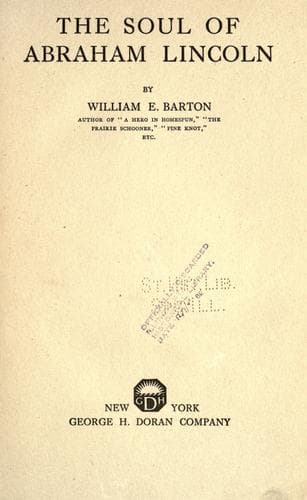
The Soul of Abraham LincolnBarton, William E. (William Eleazar)
Religion
The Soul of Abraham Lincoln
Barton, William E. (William Eleazar)
Lincoln, Abraham, 1809-1865 -- Religion; Presidents -- United States -- Biography
The slavery issue was becoming dominant. Lincoln was not at the outset
an abolitionist, and was unwilling to be placed in a position where
he would be compelled to imperil his political chances by taking too
definite a stand on this divisive measure; but on March 3, 1837,
he introduced into the Legislature a vigorous protest against the
aggressions of the pro-slavery party, a protest which probably failed
to affect his political future because it contained only one signature
beside his own. Only a few months later occurred the martyrdom of Owen
Lovejoy at Alton, and the slavery issue was no longer one to be kept
in the background. It is good to be able to remember that Lincoln's
first protest against it was recorded before it had become so burning
an issue. He himself dated his hostility to slavery to what he saw of a
slave market in New Orleans when he visited that city as a boat hand.
But he was unable to remember a time when he had not believed that
slavery was wrong.
On other moral questions he now began to speak. He delivered an
address on Temperance on Washington's Birthday in 1842. His first
notable oratorical flight outside the spheres of politics and law was
delivered before the Young Men's Lyceum of Springfield on January 27,
1837, and was on "The Perpetuation of Our Political Institutions."
It took him longer to say it than it did at Gettysburg, and it was
not so well said, but the rather florid lecture was intended to mean
essentially the same thing which he later expressed much more simply
and effectively.
His most important case that had a bearing on the slavery issue was
that of Bailey _vs._ Cromwell, when he was thirty-two years of age. In
preparing to argue before the Supreme Court of Illinois in favor of the
freedom of a slave girl, he learned the legal aspects of the question
which later he was to decide on its military and ethical character.
In 1858 he was an unsuccessful candidate for the United States Senate
against Stephen A. Douglas, and conducted that series of debates which
made him known throughout the nation as the champion of freedom in the
territories, and of the faith that the nation could not forever endure
half slave and half free. In the autumn of 1859 he visited Kansas, and
was hailed as the friend of freedom.
On Tuesday evening, February 27, 1860, he delivered an address in
Cooper Union in New York City, an address which greatly extended his
fame. On the preceding Sunday he attended Plymouth Church and heard and
met Henry Ward Beecher.
On May 16, 1860, he was nominated for the Presidency of the United
States by a great convention meeting in a temporary structure known as
"the Wigwam" standing on Lake and Market Streets near the junction of
the two branches of Chicago River. On November 7, 1860, he was elected
President.
Public-domain text, read in full here on John Shaqi.
Reviews
Reviews
No reviews yet
Be the first to share your thoughts on this work.
Elsewhere in the archive
Join the Discussion
Join the discussion
Sign in to leave a comment or review.
Sign InorCreate an account