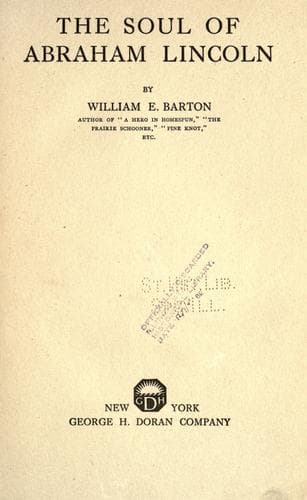
The Soul of Abraham LincolnBarton, William E. (William Eleazar)
Religion
The Soul of Abraham Lincoln
Barton, William E. (William Eleazar)
Lincoln, Abraham, 1809-1865 -- Religion; Presidents -- United States -- Biography
On Friday, November 4, 1842, he was married to Miss Mary Todd. She
was born in Lexington, Kentucky, December 13, 1818, and had come to
Springfield to be with her sister, Mrs. Ninian W. Edwards, in whose
home the marriage occurred. Concerning this marriage and the events
which went before and after, much has been written and nothing need
here be repeated.
When Lincoln arrived in Springfield, he found himself for the first
time in his life living in a town with churches that held service every
Sunday, and each church under the care of its own minister. Springfield
had several churches, and he did not at first attend any of them.
This does not seem to have been on account of any hostility which he
entertained toward them, but his first months in Springfield were
months of great loneliness and depression. He was keenly conscious of
his poverty and of his social disqualifications. He was still tortured
by his unhappy love affair with Mary Owens. More than a year after his
arrival in Springfield he wrote to her that he had not yet attended
church and giving as the reason that he would not know how to behave
himself:
"This thing of living in Springfield is rather a dull business, after
all; at least, it is so to me. I am quite as lonesome here as I ever
was anywhere in my life. I have been spoken to by but one woman since
I have been here, and should not have been by her if she could have
avoided it. I have never been to church yet, nor probably shall not
be soon. I stay away because I am conscious I should not know how to
behave myself. I am often thinking about what we said of your coming
to live at Springfield. I am afraid you would not be satisfied. There
is a great deal of flourishing about in carriages here, which it would
be your doom to see without sharing it. You would have to be poor,
without the means of hiding your poverty."
Lincoln's habit with respect to churchgoing underwent no very marked
improvement after his marriage until the year 1850. He came, however,
to know a number of ministers[19] and to sustain somewhat pleasant
relations with some of them.
Mary Todd had been reared a Presbyterian. For a time after her
marriage she attended and was a member of the Episcopal Church. On
February 1, 1850,[20] their second son, Edward Baker Lincoln, died.
The little boy was between three and four years old. The rector of the
Episcopal Church was absent from the city and the funeral service was
conducted by Rev. James Smith, D.D., of the First Presbyterian Church.
A friendship was established between them, and Mr. Lincoln took a pew
in Dr. Smith's church and he and Mrs. Lincoln attended there regularly.
In a later chapter we shall have occasion to consider more directly and
at length the influence of Dr. Smith upon Mr. Lincoln. We now confine
ourselves to the fact that Lincoln now became a church attendant under
the ministry of a preacher quite different from any he had previously
known.
Public-domain text, read in full here on John Shaqi.
Reviews
Reviews
No reviews yet
Be the first to share your thoughts on this work.
Elsewhere in the archive
Join the Discussion
Join the discussion
Sign in to leave a comment or review.
Sign InorCreate an account