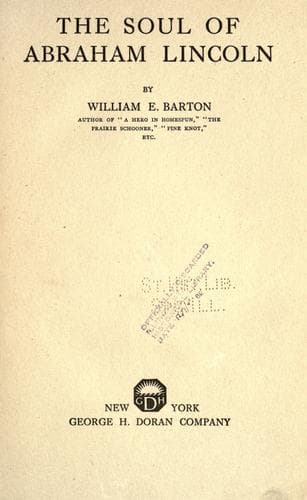
The Soul of Abraham LincolnBarton, William E. (William Eleazar)
Religion
The Soul of Abraham Lincoln
Barton, William E. (William Eleazar)
Lincoln, Abraham, 1809-1865 -- Religion; Presidents -- United States -- Biography
Lincoln's religious life in Springfield has been and is the subject of
violent controversy. Much that has been written on both sides bears
the marks of prejudice and exhibits internal evidence of having been
consciously or unconsciously distorted. In a later chapter it will come
before us for review and analysis. Of it we may now remind ourselves
that in this period covering nearly a quarter of a century Lincoln
was developing in many ways. He emerged from grinding poverty into a
condition in which he owned a home and had a modest sum of money in the
bank. From an ill-trained fledgling lawyer, compelled by his poverty
to share a bed in a friend's room above the store, he had come to be a
leader at the Illinois bar. From an obscure figure in State politics
he had come to be the recognized leader of a political party that was
destined to achieve national success and to determine the policies of
the nation with little interruption for more than half a century. Out
of a condition of great mental uncertainty in all matters relating to
domestic relations he had come into a settled condition as the husband
of a brilliant and ambitious woman and the father of a family of sons
to whom he was devotedly attached. For the first time in his life he
lived in a community where there were buildings wholly dedicated to
the purposes of public worship; and after a considerable period of
non-church attendance, and perhaps another of infrequent or irregular
attendance, he had become a regular attendant and supporter of a church
whose minister was his personal friend and whom he greatly admired.
During his years in Springfield, Mr. Lincoln's political ideals had
undergone marked change. His experience in the Illinois Legislature is
not discreditable; neither does it manifest any notably high ideals.
Nor was he brilliantly successful in his one term in Congress. Lincoln
was an honest politician, in the sense that he kept his promises and
stood by his announced convictions. But it is impossible to read into
his legislative history any such lofty purpose as later possessed him.
He and the other members of the "Long Nine" log-rolled in orthodox
political fashion, and won from Governor Ford the title "spared
monuments of popular wrath."[21]
As a jury lawyer, also, his arts were those of the successful trial
lawyer of the period. So far as the author has been able to find,
there was no unworthy chapter in all this long history. The story,
for instance, that in the trial of Armstrong Lincoln used an almanac
of another year and won his case by fraud, has, as the author is
convinced, no foundation whatever in fact. On the contrary, Lincoln was
at a serious disadvantage in any case in whose justice he did not fully
believe.
Public-domain text, read in full here on John Shaqi.
Reviews
Reviews
No reviews yet
Be the first to share your thoughts on this work.
Elsewhere in the archive
Join the Discussion
Join the discussion
Sign in to leave a comment or review.
Sign InorCreate an account