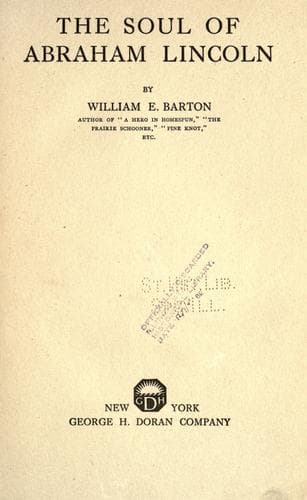
The Soul of Abraham LincolnBarton, William E. (William Eleazar)
Religion
The Soul of Abraham Lincoln
Barton, William E. (William Eleazar)
Lincoln, Abraham, 1809-1865 -- Religion; Presidents -- United States -- Biography
But there came a time when Lincoln was more than a shrewd and
honest politician; more than a successful jury lawyer. In the brief
autobiographical sketch which he prepared for Mr. Fell, he speaks of
his work at the end of his term in Congress, and says:
"In 1846 I was once elected to the lower House of Congress. Was not
a candidate for re-election. From 1849 to 1854, both inclusive,
practiced law more assiduously than ever before. Always a Whig in
politics, and generally on the Whig electoral tickets, making active
canvasses, I was losing interest in politics when the repeal of the
Missouri Compromise aroused me again. What I have done since is pretty
well known."
He expanded this brief statement somewhat in the sketch which he
furnished a little later to Scripps as a basis of his campaign
biography:
"Upon his return from Congress, he went to the practice of the law
with greater earnestness than ever before.... In 1854 his profession
had almost superseded the thought of politics in his mind, when the
repeal of the Missouri Compromise aroused him as he had never been
before."
The full effect of this unprecedented arousing was manifest
in his speech at Springfield on June 16, 1858, the
"House-Divided-Against-Itself" speech.
Lincoln himself is our authority for the statement that the moral
aspects of the slavery issue called him back into politics and roused
him as he never before had been aroused. Politically, at least, Abraham
Lincoln had been born again. Nor had it been a period of spiritual
inaction or retrogression, as we have seen and shall see yet further.
In addition to all this he had known the discipline of sorrow, and had
had occasion to test religion on the practical side of its availability
for comfort in time of bereavement. He had now been chosen to a
position of responsibility such as no man in all the history of his
nation had ever been called upon to occupy.
Public-domain text, read in full here on John Shaqi.
Reviews
Reviews
No reviews yet
Be the first to share your thoughts on this work.
Elsewhere in the archive
Join the Discussion
Join the discussion
Sign in to leave a comment or review.
Sign InorCreate an account