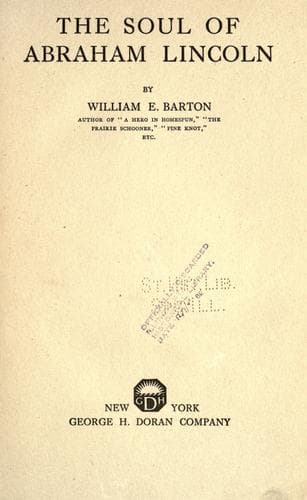
The Soul of Abraham LincolnBarton, William E. (William Eleazar)
Religion
The Soul of Abraham Lincoln
Barton, William E. (William Eleazar)
Lincoln, Abraham, 1809-1865 -- Religion; Presidents -- United States -- Biography
THE ENVIRONMENT OF LINCOLN'S LIFE IN WASHINGTON
ABRAHAM LINCOLN was inaugurated sixteenth president of the United
States, on Monday, March 4, 1861. His journey to Washington had served
to impress him even more deeply than before with a sense of the
solemnity of his task. He still was earnestly hoping, and if we may
judge from his speeches along the route, even expecting, that war would
be averted;[22] but the possibility of war was always apparent and its
probability was growing daily more certain.
Several incidents are related tending to show the solemnity of
Lincoln's feeling at this time. Some of them are plainly apocryphal,
but others are deeply significant. The following was related by Rev.
Dr. Miner, pastor of the First Baptist Church of Springfield, who
was intimately acquainted with the Lincoln family and who visited
them in the White House. This story he declared was related to him by
Mrs. Lincoln on the occasion of his visit to the White House and was
published while Mrs. Lincoln was still living. It appears to rest upon
a sound basis of fact:
"Here I relate an incident which occurred on the 4th of March, 1861,
as told me by Mrs. Lincoln. Said she:
"'Mr. Lincoln wrote the conclusion of his inaugural address the
morning it was delivered. The family being present, he read it to
them. He then said he wished to be left alone for a short time. The
family retired to an adjoining room, but not so far distant but that
the voice of prayer could be distinctly heard. There, closeted with
God alone, surrounded by the enemies who were ready to take his
life, he commended his country's cause and all dear to him to God's
providential care, and with a mind calmed by communion with his Father
in heaven, and courage equal to the danger, he came forth from that
retirement ready for duty.'"--_Scribner's Monthly_, 1873, p. 343.
Fort Sumter fell April 13, and on the 15th Lincoln issued his call for
volunteers, and called Congress in extraordinary session for July 4. On
July 21 occurred the battle of Bull Run, and the war settled down to
its weary and varying fortunes. On September 22, 1862, he issued the
Emancipation Proclamation to take effect January 1, 1863. The battle
of Gettysburg occurred July 1-4, 1863, and destroyed the hope of the
Southern Army of a successful invasion of the North. Simultaneously
with Lee's defeat at Gettysburg, General Grant captured Vicksburg,
opening the Mississippi to the Union gunboats. On November 19, 1863,
Lincoln delivered his Gettysburg address. On March 4, 1865, he was
inaugurated President a second time. On Sunday, April 9, 1865, General
Lee surrendered his army at Appomattox. On Friday night, April 14, at
10:20 P.M., Abraham Lincoln was shot in Ford's Theater and died on
Saturday morning, April 15, at 7:22. On Thursday, May 4, his body was
interred at Oak Ridge Cemetery in Springfield.
Public-domain text, read in full here on John Shaqi.
Reviews
Reviews
No reviews yet
Be the first to share your thoughts on this work.
Elsewhere in the archive
Join the Discussion
Join the discussion
Sign in to leave a comment or review.
Sign InorCreate an account