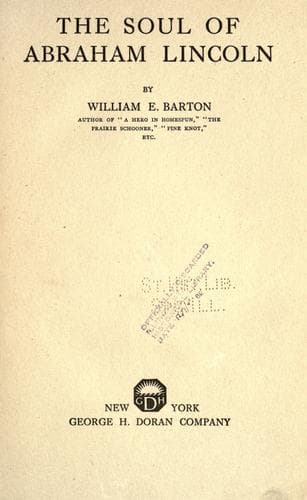
The Soul of Abraham LincolnBarton, William E. (William Eleazar)
Religion
The Soul of Abraham Lincoln
Barton, William E. (William Eleazar)
Lincoln, Abraham, 1809-1865 -- Religion; Presidents -- United States -- Biography
On the day before he was fifty-two years old he stood upon the platform
of a railroad train ready to leave Springfield for the last time.
He did not know that it was the last time, but he had a haunting
presentiment that it might be so. With tears filling his eyes and in
a voice choked with emotion he spoke his last words to his neighbors
and friends. Just what he said we shall never know. A shorthand
reporter endeavored to write it down, but with indifferent success.
Hon. Newton Bateman, State Superintendent of Schools, of whom we shall
hear later, hurried to his office after the train pulled out and wrote
down what, judged by any reasonable test, must be considered a very
satisfactory report of it. Lincoln sat down in the train after it had
left Springfield and endeavored to recall the exact language which
he had used, and in this was assisted by his private secretary, John
Hay. Of these three, and a considerable number of other versions, the
Illinois Historical Society has chosen the third as the authentic
version. It represents what Lincoln wished to be remembered as having
said, and very nearly what he actually did say. This version of his
farewell address, representing the deep feeling of his heart at
the hour of parting, and recorded on the same day as embodying his
deliberate revision of the extempore utterance, is taken from Nicolay
and Hay's edition of his Life and of his Works. It is that which was
cast in bronze and placed in the year of his Centennial, in front of
the State House at Springfield. If one would measure the growth of
Abraham Lincoln intellectually and spiritually he might ask, What kind
of an address in comparison with this Lincoln might have delivered on
his departure from Kentucky in 1816, from Indiana in 1830, or from New
Salem in 1837? The answer is so emphatic as almost to make the question
absurd; but it is worth while to ask the question before we read again
the familiar words of his farewell address. No one reading these few
sentences can question the sincerity of Lincoln's utterance or the
depth of his religious feeling:
"My friends: No one, not in my situation, can appreciate my feeling
of sadness at this parting. To this place, and the kindness of these
people, I owe everything. Here I have lived a quarter of a century,
and have passed from a youth to an old man. Here my children have been
born, and one is buried. I now leave, not knowing when or whether
ever I may return, with the task before me greater than that which
rested upon Washington. Without the assistance of that Divine Being
who ever attended him I cannot succeed. With that assistance, I cannot
fail. Trusting in Him, who can go with me, and remain with you and
be everywhere for good, let us confidently hope that all will yet be
well. To His care commending you, as I hope in your prayers you will
commend me, I bid you an affectionate farewell."--NICOLAY AND HAY,
III, 291.
CHAPTER VI
Public-domain text, read in full here on John Shaqi.
Reviews
Reviews
No reviews yet
Be the first to share your thoughts on this work.
Elsewhere in the archive
Join the Discussion
Join the discussion
Sign in to leave a comment or review.
Sign InorCreate an account