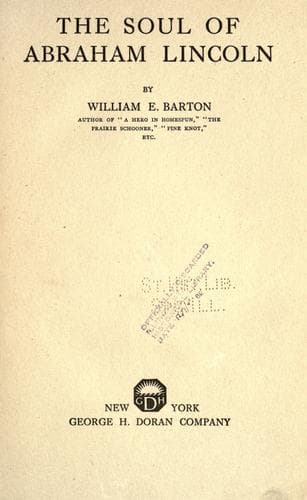
The Soul of Abraham LincolnBarton, William E. (William Eleazar)
Religion
The Soul of Abraham Lincoln
Barton, William E. (William Eleazar)
Lincoln, Abraham, 1809-1865 -- Religion; Presidents -- United States -- Biography
THUS far we have dealt primarily with the environments of Lincoln's
religious life. We have not been able to escape the conviction
that Lincoln's religious life was an evolution, influenced by his
environment and experience. We have considered in these successive
chapters some matters in detail which seemed to belong particularly to
the respective periods of which those chapters have treated; but we
have reserved, in general, the evidence that bears upon his religion as
a whole for more critical examination. Particularly have we reserved
those portions of the evidence which, first published after his death,
belong to no one epoch of his life and have become the occasion of
controversy. What kind of man he was religiously in 1865 we shall hope
to know better; indeed, it is not unreasonable to hope that examination
may show in part the processes by which his religion found its final
form and expression.
We know already that there had been a development. We know that the
Abraham Lincoln who in 1834 delivered his political opinions in
labored and florid style and with the logic current in stump oratory
had undergone mental development and had emerged into the Lincoln who
delivered his thoughts in translucent Anglo-Saxon at Gettysburg and the
Second Inaugural. That there had been a moral and spiritual development
also we have already been assured. Perhaps it was greater than he
himself consciously understood. We shall now endeavor to ascertain what
it had come to be.
In this inquiry we have no easy task. The mass of evidence is great,
and the contradictions are many. There were contradictions in the
personality of the man himself, and many contradictions in the views
which men, even honest and unprejudiced men, had of him; and not all
the testimony is unprejudiced.
Lincoln was a man of many moods. He reacted differently to different
stimuli, and to the same stimulus at different times. His feelings ran
the gamut from abysmal dejection to rollicking gaiety: and he never
revealed his whole nature to any one man, nor showed the whole of his
nature at any one time. He cannot be judged by the mechanical tests of
a rigid consistency: for he was not that kind of man.
When Dr. J. G. Holland went to Springfield immediately after the death
of Lincoln to gather material for his biography he was surprised beyond
measure to find how conflicting were the local judgments of Lincoln's
character. Concerning this he wrote:
"Such a nature and character seem full of contradictions; and a man
who is subject to such transitions will always be a mystery to those
who do not know him wholly. Thus no two men among his intimate friends
will agree concerning him.
Public-domain text, read in full here on John Shaqi.
Reviews
Reviews
No reviews yet
Be the first to share your thoughts on this work.
Elsewhere in the archive
Join the Discussion
Join the discussion
Sign in to leave a comment or review.
Sign InorCreate an account