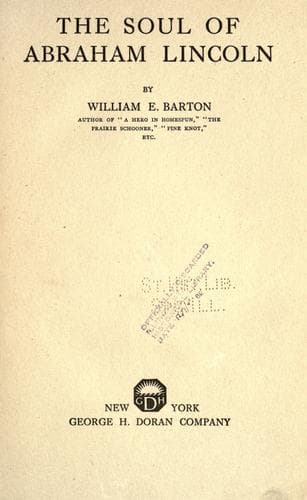
The Soul of Abraham LincolnBarton, William E. (William Eleazar)
Religion
The Soul of Abraham Lincoln
Barton, William E. (William Eleazar)
Lincoln, Abraham, 1809-1865 -- Religion; Presidents -- United States -- Biography
Perhaps more than all else, the moral aspects of the slavery question
thrust themselves into a foremost place in his religious thinking. We
need not trouble ourselves overmuch about the accuracy of John Hanks's
story that when Lincoln saw slaves sold in the market in New Orleans he
vowed to "hit that institution and hit it hard"; part of that story may
have originated in John's fertile imagination. But the story is not an
unworthy one, and we know from Lincoln's own declaration that on that
very occasion he was smitten with a sense of the iniquity of slavery,
and that on its moral rather than its political side. That he freed
the slaves as a war measure, and that he must thus justify the action
as an extra-constitutional prerogative, need not lessen in our mind
the moral aspects of the decision. The evidence is incontestable, and
we shall quote it later, that to him it was a solemn obligation, the
fulfillment of a vow which he had made to God.
We are presently to go into a detailed examination of the available
evidence concerning Lincoln's religious life. We are here considering
his environment in the successive stages of his career, and his visible
reaction to it. But even if we were to go no further, we should find
ourselves compelled to believe in the reality of Lincoln's religion.
We might not be able accurately to define it, and we may not be able
to do so to our complete satisfaction after we have finished; we might
even question, and we may still question, whether he himself ever fully
defined it. But we are assured that his religion was real and genuine,
and that it grew more vital as he faced more completely the moral and
spiritual aspects of the work to which, as he honestly believed, he was
divinely called.
When General Lee surrendered his armies on April 9, 1865, Mr. Stanton,
Secretary of War, though not a very religious man in his profession,
felt with the whole nation the Providence of God in the result. He
surrounded the dome of the Capitol with a transparency, reading, "This
is the Lord's doing, and it is marvelous in our eyes."
He believed it; the nation believed it; Abraham Lincoln believed it.
That conviction that the hand of God had been in it all had but lately
been expressed in his Second Inaugural. That faith was warm in his
heart, and its expression fresh upon his lips, when on April 14, 1865,
he was shot and killed.
So ended the earthly life of Abraham Lincoln; and with that end came
the beginning of the discussion of his religion. To the history of that
discussion, and the critical consideration of the evidence which it
adduced, we are now to address ourselves.
PART II: AN ANALYSIS OF THE EVIDENCE
CHAPTER VII
THE RULES OF EVIDENCE
Public-domain text, read in full here on John Shaqi.
Reviews
Reviews
No reviews yet
Be the first to share your thoughts on this work.
Elsewhere in the archive
Join the Discussion
Join the discussion
Sign in to leave a comment or review.
Sign InorCreate an account