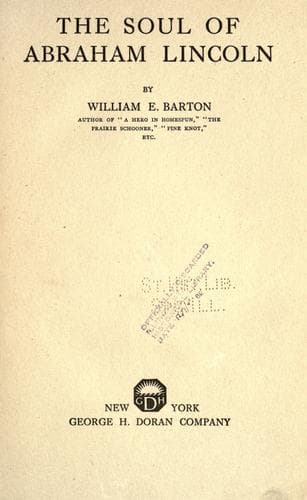
The Soul of Abraham LincolnBarton, William E. (William Eleazar)
Religion
The Soul of Abraham Lincoln
Barton, William E. (William Eleazar)
Lincoln, Abraham, 1809-1865 -- Religion; Presidents -- United States -- Biography
We have a yet further difficulty to face in the conflict of testimony
of habitually truthful people. If it were becoming in the author of
a book such as this to pass any general criticism upon those authors
who have preceded him in the same field, it might, perhaps, be counted
not invidious to say that for the most part writers on the religion of
Lincoln have been content to adduce the testimony of a limited number
of apparently truthful witnesses in support of their theory, but have
not given the evidence very much examination beyond the general fact
that the witnesses were habitually truthful people. We shall not arrive
at the truth in this fashion.
We may borrow an illustration from a field which lies just outside the
scope of our present inquiry. Even to this day it is possible to start
a warm discussion almost anywhere in Springfield over the question of
Lincoln's domestic affairs. It is possible to prove on the testimony
of unimpeached witnesses that Lincoln loved his wife passionately, and
that he did not love her at all; that he married Mary Todd because he
loved her and had already answered in his own heart all his previous
questions and misgivings, and that he married her because she and her
relatives practically compelled him to do so, and that he went to the
marriage altar muttering that he was going to hell; that Mary Todd
not only admired Abraham Lincoln, but loved him with a beautiful and
wifely devotion, and that she hated him and never ceased to wreak
revenge upon him for having once deserted her upon the eve of their
announced marriage; that Mary Todd wore a white silk dress on the night
of her wedding, and that she never owned a white silk dress until she
had become a resident of the White House; that the wedding was a gay
affair, with a great dinner, and was followed by a reception for which
several hundred printed invitations were issued, and that the wedding
was hastily performed on a Sunday evening, Mr. Dresser, the minister,
cutting short his evening service and dropping in on the way home
to solemnize a quickly extemporized marriage contract. It would seem
fairly easy to discover from a calendar of the year 1842 at least
what day in the week was chosen for the wedding, but few if any of
the disputants, or even of the biographers, appear to have taken this
pains. If the present writer should ever have occasion to write about
Abraham Lincoln's married life, he would not proceed very far without
consulting a calendar for that year; and he would hope to settle at
least one point in the controversy by telling the world that in 1842
the fourth day of November did not occur on Sunday or Tuesday, but on
Friday;[28] Mr. and Mrs. Lincoln both being tinged with superstition,
he might raise the question whether the celebration of the wedding upon
that date probably was or was not long premeditated. But the present
book does not concern itself with these questions, and the matter is
Public-domain text, read in full here on John Shaqi.
Reviews
Reviews
No reviews yet
Be the first to share your thoughts on this work.
Elsewhere in the archive
Join the Discussion
Join the discussion
Sign in to leave a comment or review.
Sign InorCreate an account