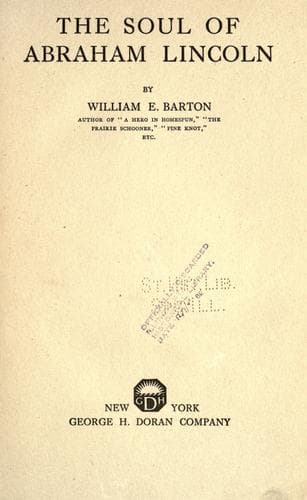
The Soul of Abraham LincolnBarton, William E. (William Eleazar)
Religion
The Soul of Abraham Lincoln
Barton, William E. (William Eleazar)
Lincoln, Abraham, 1809-1865 -- Religion; Presidents -- United States -- Biography
here introduced merely to illustrate that no point in controversy in a
matter of this character can be definitely settled by the unsupported
testimony of a single honest witness relying upon his memory after the
lapse of many years.
Evidence such as we are to consider is of two kinds, known in logic
as _a priori_ and _a posteriori_. The first kind is evidence from
antecedent probability; the second is evidence relating to matter after
the fact. An illustration will serve:
A man is found dead, with a wound in his forehead, and there are no
witnesses who can be produced in court who saw the man die. The wound
appears to have been produced by a bullet, and, as no weapon is found
beside the body, there is a presumption that the man has been murdered.
A neighbor is accused of having committed the deed. The _a priori_
evidence is adduced in testimony that the defendant and the deceased
had long been on bad terms with each other on account of a line fence
between their adjacent properties; that the defendant had threatened
to kill the deceased and had recently bought a revolver. The evidence
_a posteriori_ is found in the fact that the defendant's revolver on
examination shows one empty chamber and that the ball in the deceased
man's brain is of the caliber suited to his weapon and of the same
manufacture as the unused cartridges in the weapon. To this may be
added other incriminating facts, as of measured footprints near the
scene of murder which correspond to the size of the defendant's boots,
and of possible blood stains upon his clothing.
A very large volume of _a priori_ evidence is sometimes set aside
by a single _a posteriori_ fact; for instance, in the foregoing
supposititious case it may be entirely possible to prove that the
murder was committed by a tramp, and that the defendant was ten miles
away at the time the deed was done.
On the other hand, a large volume of _a posteriori_ evidence sometimes
disappears in the face of a single _a priori_ consideration. A man is
accused of having stolen a sheep. It is shown in evidence that on the
evening when the sheep was stolen he walked through his neighbor's
pasture and was seen to approach the sheep; that he sold mutton on the
day after the loss of the sheep, and that a fresh sheepskin was found
nailed to his barn door. All this _a posteriori_ evidence and much more
may be completely set aside in the minds of the jury by the single fact
that the man accused has lived for forty years in the community and has
borne a reputation incompatible with the crime of sheep-stealing.
In the examination of testimony concerning alleged utterances of
Abraham Lincoln in matters of religious belief, we must ask such
questions as these:
Public-domain text, read in full here on John Shaqi.
Reviews
Reviews
No reviews yet
Be the first to share your thoughts on this work.
Elsewhere in the archive
Join the Discussion
Join the discussion
Sign in to leave a comment or review.
Sign InorCreate an account