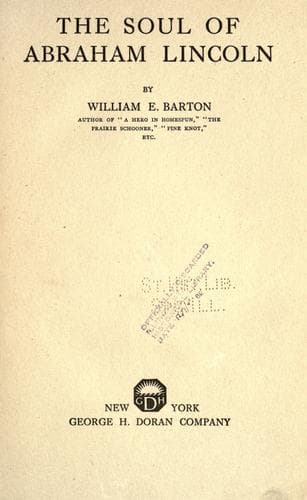
The Soul of Abraham LincolnBarton, William E. (William Eleazar)
Religion
The Soul of Abraham Lincoln
Barton, William E. (William Eleazar)
Lincoln, Abraham, 1809-1865 -- Religion; Presidents -- United States -- Biography
Mr. Bateman was, indeed, in an uncomfortable position and any one
of the three ways out of it seemed likely to make it still more
uncomfortable. He continued to maintain a profound silence. Years
afterward when Arnold was preparing his _Life of Lincoln_ for the press
and Arnold asked him concerning the truth of the incident as recorded
by Holland, he replied with extreme brevity that it was "substantially
correct." (Arnold: Life of Lincoln, p. 179).
The only portion of Bateman's admission to Herndon which Bateman
finally, and with great reluctance, consented to have published, was
one which covered the alleged utterance "Christ is God." It was a
letter written in 1867, and marked "Confidential." In this letter
Bateman said:
"He [Lincoln] was applying the principles of moral and religious truth
to the duties of the hour, the condition of the country, and the
conduct of public men--ministers of the gospel. I had no thought of
orthodoxy or heterodoxy, Unitarianism, Trinitarianism, or any other
ism, during the whole conversation, and I don't suppose or believe he
had."
This is a guarded letter, but it is sufficiently specific for our
purposes. If the conversation between Bateman and Lincoln was of this
character, with nothing to distinguish the view of Lincoln as Unitarian
or Trinitarian, Lincoln certainly did not say:
"I know I am right because I know that liberty is right, for Christ
teaches it, and Christ is God."
It is evident that Bateman, crowded by Herndon in repeated
cross-examination, came as near to repudiating those parts of the
interview to which Herndon objected as he could do without raising
publicly the issue of veracity between himself and Holland. The
attitude of Dr. Bateman in this matter forbids us to believe that the
story as it stands in Holland's book can be true.
Bateman is not mentioned in the index of Nicolay and Hay's _Life of
Lincoln_, and it is practically certain that they did not credit the
incident.
What, under these circumstances, shall be our judgment concerning this
most hotly contested of all incidents concerning the religious life of
Abraham Lincoln?
Public-domain text, read in full here on John Shaqi.
Reviews
Reviews
No reviews yet
Be the first to share your thoughts on this work.
Elsewhere in the archive
Join the Discussion
Join the discussion
Sign in to leave a comment or review.
Sign InorCreate an account