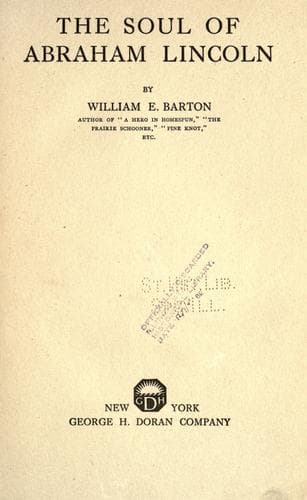
The Soul of Abraham LincolnBarton, William E. (William Eleazar)
Religion
The Soul of Abraham Lincoln
Barton, William E. (William Eleazar)
Lincoln, Abraham, 1809-1865 -- Religion; Presidents -- United States -- Biography
The incident had a basis of fact. Neither Bateman nor Holland would
have created such a story out of whole cloth. But Bateman was under
very strong temptation to enlarge upon the incident, and had had
five years in which to magnify it in his own mind. The then recent
death of Mr. Lincoln and the strong desire of Christian people for a
clear statement of his faith, made it easy to color the recollection
and sketch in details, which did not seem to be important departures
from the truth when related in verbal conversation, but which had a
different look when they appeared in cold type. Holland, who was a
writer of fiction as well as history, did not fail to embellish the
story as Bateman told it to him. He probably did not write it down
at the time, but recalled it afterward from memory, and in his final
report it underwent additional coloring and the sketching in of detail.
Neither of these two men intentionally falsified, but between the two
the story was materially enlarged, and there was an undistributed
margin of error between the original event as it occurred in 1860 and
the very pretty story which Holland printed in 1865. Neither Holland
nor Bateman cared, probably, to face too searching an inquiry as to how
that enlargement had come.
Dr. Bateman was a man of probity and upright character. He never
willfully misrepresented. But he had a rhetorical mind; not only his
style, but his mind, was rhetorical. He embellished his narratives
because it was in him to do so. The two reports which he made of
Lincoln's farewell address in Springfield[30] showed, both of them,
such embellishments,[31] and he was as unconscious that he in later
years enlarged upon his own first report as he was that his first
report enlarged upon the address itself. These enlargements were
slight, and did not destroy nor greatly alter the sense; but his
changes never tended to simplicity. He was a master of good English
style, but it was a grander, more rhetorical style than that of
Lincoln. Lincoln, after receiving his special notice of nomination,
submitted his letter of acceptance to Bateman, and at Bateman's
suggestion changed a split infinitive. Lincoln knew that Bateman was
an authority on good English, and respected his opinion and valued
his friendship. Whatever enlargements Bateman's memory made upon
his interview with Lincoln were made without intent to deceive; and
whatever Holland added was added without intent to deceive. But the
interview of 1860 and the story about it in Holland's book five years
later have between them a discrepancy which must be distributed in a
ratio which we are not able positively to determine between two good
and truthful men, each of whom enlarged a little upon the material that
was given to him.
Public-domain text, read in full here on John Shaqi.
Reviews
Reviews
No reviews yet
Be the first to share your thoughts on this work.
Elsewhere in the archive
Join the Discussion
Join the discussion
Sign in to leave a comment or review.
Sign InorCreate an account