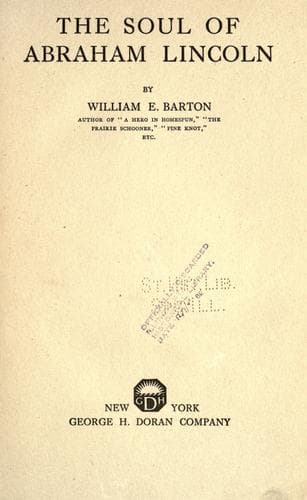
The Soul of Abraham LincolnBarton, William E. (William Eleazar)
Religion
The Soul of Abraham Lincoln
Barton, William E. (William Eleazar)
Lincoln, Abraham, 1809-1865 -- Religion; Presidents -- United States -- Biography
Among these were letters from men who professed to have heard Lincoln
charged with infidelity and had heard him deny it. The most important
of these letters, however, aside from that of Mentor Graham, have value
for us in the light they shed upon what really constituted Lincoln's
alleged infidelity at this early period. That he had doubts and
misgivings upon various subjects was not denied, but his hostility to
the orthodox belief expressed itself chiefly in a vigorous denial of
the endlessness of future punishment. This dogma Lincoln denied upon
two grounds, as these letters affirm. First, the justice and mercy of
God; and secondly, the fact that according to the Biblical scheme of
redemption, whatever right the human race had possessed to immortality
and lost through sin, had been restored in Christ. Lincoln was,
according to the testimony of a number of these men who had known him,
not an infidel, nor even a deist, but essentially a Universalist.
Irwin had interviewed Colonel James H. Matheny and quoted Matheny as
denying that he had ever heard Lincoln admit that he was an infidel and
did not himself believe it. Irwin himself had known Lincoln personally
for many years and had known large numbers of men who were intimately
acquainted with him and he said:
"I have never yet heard one single man express the belief that Lincoln
was an infidel. Mr. Herndon, it is true, did have opportunities over
others in knowing Mr. Lincoln's religious opinions, but other men
had some opportunities, as well as Mr. Herndon, and to them I shall
have to appeal, for I do not claim to personally know anything about
Mr. Lincoln's religious faith. Though personally acquainted with Mr.
Lincoln for twenty-eight years and often in his office, I never heard
him say a word on the subject of his religious belief."
It will be noted that while the statements concerning Mr. Lincoln's
alleged infidelity have been published over the name of Lamon, Herndon
was held responsible for them in these controversies. The impetuous
Herndon possessed none of the reticence of Bateman; and while denying
that he wrote Lamon's book, rushed in as Lamon's champion and covered
himself with wounds if not with glory.
Irwin's article proceeds to quote these old neighbors and friends of
Lincoln, whose testimony, added to those adduced by Dr. Reed, was
of very great weight. I have copied these[37] from the files of
the _Illinois State Journal_ in the Library of the Illinois State
Historical Society in Springfield and here produce three of them,
reserving others for later comment.
One of the letters quoted in full by Irwin was from Thomas Mostiller,
of Pleasant Plains, Menard County, Illinois. He professed to have heard
Lincoln when he was a candidate for Congress in 1847 or 1848, when he
was charged with being an infidel and explicitly denied it. Said he:
Public-domain text, read in full here on John Shaqi.
Reviews
Reviews
No reviews yet
Be the first to share your thoughts on this work.
Elsewhere in the archive
Join the Discussion
Join the discussion
Sign in to leave a comment or review.
Sign InorCreate an account