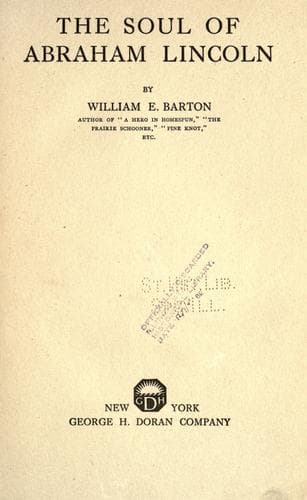
The Soul of Abraham LincolnBarton, William E. (William Eleazar)
Religion
The Soul of Abraham Lincoln
Barton, William E. (William Eleazar)
Lincoln, Abraham, 1809-1865 -- Religion; Presidents -- United States -- Biography
"He did not nor could not believe in the endless punishment of any
one of the human race. He understood punishment for sin to be a
Bible doctrine; that punishment was parental in its object, aim and
design, and intended for the good of the offender; hence it must
cease when justice was satisfied. He added that all that was lost by
the transgression of Adam was made good by the atonement; all that
was lost by the fall was made good by the sacrifice; and he added
this remark, that punishment being a 'provision of the gospel system,
he was not sure but the world would be better off if a little more
punishment was preached by our ministers, and not so much of pardon of
sin.'"
I need only add, that to me these letters carry the conviction of
reality. Lincoln had been rooted and grounded in the kind of dogma that
began with Adam and related to his fall in vital sort the atonement of
Christ. That Lincoln had some doubts concerning the person of Christ
is not in point. He believed in God, and he knew the fact of sin, and
he was dyed in the wool in arguments concerning the fall of the race
in Adam and its redemption in Christ. But he did not dwell as did the
preachers on individual forgiveness, which he sometimes doubted, but
sought to evolve a legal and moral scheme with a final restoration. I
regard these testimonies as essentially true.
CHAPTER XI
THE HERNDON LECTURES, LETTERS, AND BIOGRAPHY
THE name of William H. Herndon finds frequent mention in these pages,
as it must in any study of Abraham Lincoln. With all his faults as
a biographer, his astigmatism, his anti-religious prejudice, his
intolerance, his bad taste, he is an invaluable source of information
concerning his partner and friend, Abraham Lincoln.
The publication of the Lamon biography and the Reed lecture brought him
into a conflict from which no power on earth could probably have kept
him out, and in it he did and said many things which for his own sake
and Lincoln's he might better not have said.
But Herndon was no liar. Biased as he was, and himself a free-thinker
or perhaps worse, he told the truth in such fashion as to throw it out
of perspective, and sometimes told what he believed to be the truth in
a passion which compels us to discount some of his testimony. But he
did not lie nor intentionally misrepresent.
For twenty years Lincoln and Herndon were law partners, and their
partnership was never formally dissolved. Lincoln liked Herndon, but
there was no loss of love between Herndon and Mrs. Lincoln. She, if
tradition about Springfield is to be believed, disliked him personally
for his habits, and possibly also for his politics, for he was an
Abolitionist before Lincoln, and a very ardent one at that. Had she
known what Herndon was to say about her in later years she might have
been more gracious to her husband's junior partner, who had learned
some habits at the bar of his father's tavern which he might better not
have learned.
Public-domain text, read in full here on John Shaqi.
Reviews
Reviews
No reviews yet
Be the first to share your thoughts on this work.
Elsewhere in the archive
Join the Discussion
Join the discussion
Sign in to leave a comment or review.
Sign InorCreate an account