African Americans; United States -- Race relations
The South grew sulky, grew infinitely suspicious and restive, and
irritated and fearful. It began to fear a general slaves’ rising. The
numerical superiority of the Negroes presented itself to the mind as
an ever-growing menace. The idea of emancipation was fraught with the
economic ruin it implied. It is difficult now to resurrect the mind of
society preceding the time of the great Civil War. It is the fashion
to emphasize the technical aspect of the quarrel of North and South,
and to say that the war was fought in order that the Union might be
preserved. But it is truer to say that it was fought because the South
wanted to secede. And the South wished to secede because it saw more
clearly every day that the institution of slavery was in danger. Every
month, every year, saw its special occasions of irritation, premonitory
splashing out of flame, petty explosions and threats. More slaves
escaped every year. The Underground Railway, so called, by which the
Friends succored the poor runaways and brought them out of danger and
distress into the sanctuary of the North grew to be better and better
organized. On the other hand, the punishments of discovered runaways
grew more barbarous and more public, and the rage of the North was
inflamed.
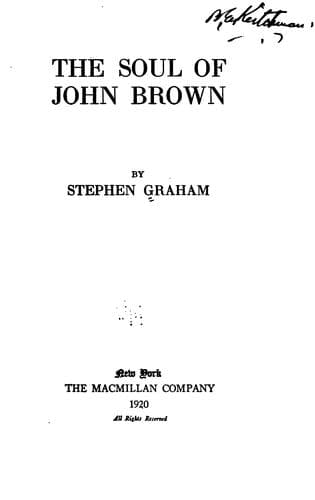
Heroic John Brown made his abortive bid to light up a slaves’
insurrection by his wild exploit of Harper’s Ferry. And then John
Brown, old man as he was, of apostolic aspect and fervor, was tried and
condemned. He did not fear to die. But he wrote to his children that
they should “abhor _with undying hatred_ that sum of all villainies,
slavery,” and while he was being led to the gallows he handed to a
bystander his last words and testament—
I, John Brown, am now quite _certain_ that the crimes of this _guilty
land_ will never be purged away but with blood. I had _as I now think
vainly_ flattered myself that without _very much_ bloodshed it might
be done....
And in his ill-fitting suit and trousers and loose carpet slippers John
Brown was hanged silently and solemnly, and all the troops watching
him, even stern Stonewall Jackson himself, were stricken with a sort of
premonitory terror. Soon came the great war.
And the slaves were made free. That is their story. Where do they stand
to-day?
II
IN VIRGINIA
Public-domain text, read in full here on John Shaqi.
Reviews
Reviews
No reviews yet
Be the first to share your thoughts on this work.
Join the Discussion
Join the discussion
Sign in to leave a comment or review.
Sign InorCreate an account