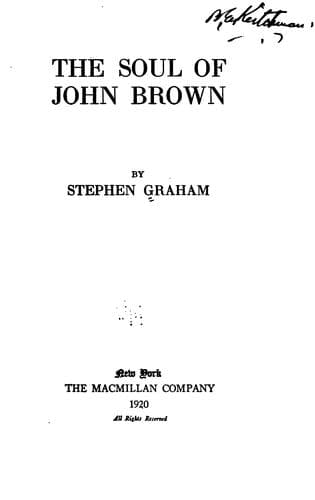
African Americans; United States -- Race relations
“To put the matter in a few words, the problem that I would like
immensely to emphasize to you, is the wholly abnormal position of
the minority seeking its rights. We are apt to think that the Negro
can achieve these rights in the way that our ancestors achieved
theirs against the aristocracy, but unless I am utterly wrong, that
view is doomed to failure and if followed will result in embittering
the relations between the races so that segregation or deportation
or extermination must result. Personally I do not believe that we
will fail, but if we succeed it will be in spite of Du Bois and of
the attitude of armed resistance. Never was a better illustration
of the wisdom under certain conditions of the Tolstoi attitude of
non-resistance.”
That of course is nicely deduced, but events are not ruled by wisdom
and logic. It might very well have been said to the Israelites during
the long period of the Plagues. It is such a period in the history of
the Negroes.
XIV
THE WORLD ASPECT
The American Negroes are the aristocrats of the Negro world. It may be
a paradox to assume that a proletariat can become an aristocracy, but
an aristocracy is the best a race can produce in culture and manners.
No doubt African Negrodom is made up of a great number of races, but
all seem to have one common interest and to yield more homage to the
name of Africa itself than to any constituent part, kingdom, or state
or pasture. The American Negro is beginning to lead Africa as he is
leading the Indies. The reason is that the children of the American
slaves have made the greatest cultural progress of all Negroes.
Though persecution has been less in some parts of Africa and on the
West Indian islands, opportunity has also been less. In 1863 America
committed herself to the task of raising her millions of black slaves
to the cultural level of white citizenship. But no one has ever essayed
to raise the savage masses of Africa much higher than the baptismal
font. It is always pointed out to the American Negro that his good
fortune is prodigious. The Negro retorts that if he has good fortune
his fathers paid for it in the sufferings of slavery, and he still pays
in the price of lynching. Yet, of course, the Negroes in Africa have
suffered greatly, and their fathers suffered greatly. No Negro can deny
that he owes America much. And Africa owes, or will owe, more still.
Public-domain text, read in full here on John Shaqi.
Reviews
Reviews
No reviews yet
Be the first to share your thoughts on this work.
Elsewhere in the archive
Join the Discussion
Join the discussion
Sign in to leave a comment or review.
Sign InorCreate an account