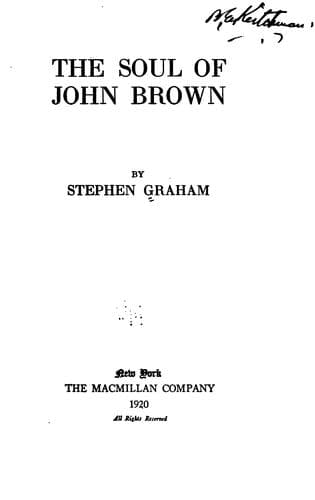
African Americans; United States -- Race relations
In America the door at least stands open for Negro progress. In Africa,
and especially in South Africa, it is not quite certain that the door
is not closed. If the door remains ajar it is not because the white
man wills it, but because the American Negro has got his foot in. A
low Commercial-Imperial idea reigns. The native is, “the labor on the
spot.” An unfailing supply of cheap native labor is considered the
great desideratum. Attempts on the Negro’s part to raise himself by
education or by technical skill are looked upon with suspicion, and one
must remember that as far as the British Empire or French or Belgian
mandatorial regions are concerned there are no institutions in Africa
comparable to Tuskegee and Hampton. If the labor unions in the United
States are foolishly antagonistic to the progress of Negro skilled
labor, they are twice more so in South Africa. If there is peonage in
America there is an abundance of pseudo slavery in Africa, and while
the American trolley car has its Jim Crow section the South African one
often has not even that, and the Negro must walk unless accompanied by
white employer. An open hostility has arisen between Black and White
which much resembles that of the Southern States of America. If it
were not for the leadership of the American Negroes it would not be
promising for Negrodom as a whole.
Of course there is a vital difference between the British Empire and
the United States; the people of the empire are subjects, and of
the republic they are citizens. While Britain technically rules her
four hundred million colored subjects _from above downward_ America
theoretically holds that all her people are free and equal. The
American ideal is higher, the British more practical.
There is another difference, and it is that our Blacks, except in
the Indies, are mostly indigenous, and have not been transplanted
from their native wilds. They have not been slaves and have not the
slave psychology. In Africa the white man is in contact with masses
of natives in a primitive condition; in the United States the Negro
has been definitely cut off from his kith and kin. The American Negro
was set free in a land rampant with democratic ideals and possessed
of a sublime belief in human progress. But Africa has been and is
increasingly a commercial domain whose only function from the modern
white man’s point of view is the making of material fortune. The white
man in Africa is much more exclusively a dollar hunter than the
American. And though Britain has been much praised for letting South
Africa govern herself it does not seem as if the Union was mating much
progress in ideals and culture. The King of England was a better friend
to the native than the local government is proving itself to be.
Public-domain text, read in full here on John Shaqi.
Reviews
Reviews
No reviews yet
Be the first to share your thoughts on this work.
Elsewhere in the archive
Join the Discussion
Join the discussion
Sign in to leave a comment or review.
Sign InorCreate an account