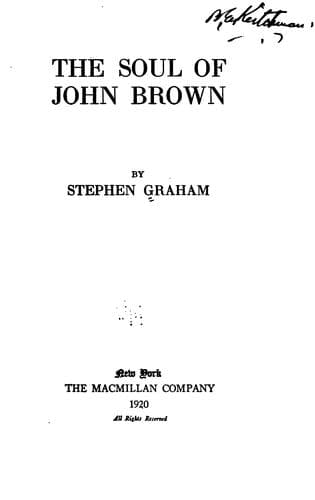
African Americans; United States -- Race relations
I suppose not many make the pilgrimage of America; land in New England
with the Puritans or sail up the James River with the Cavaliers, linger
reflectively at Mt. Vernon, consider Boston Harbor and the tax on tea,
pause at Bunker Hill, and so on—or visit Sumter, where the Stars and
Stripes were hauled down by the South, and then make the tour of the
war which followed. It would be worth while—to think a little at
Gettysburg and think again in Georgia, walking perchance to the sea
after General Sherman. No such pilgrimage would be complete without
riding the great mother river of America, and it occurred to me that
a fitting place in which to end a pilgrimage, as far as the South is
concerned, might be Vicksburg, with its vast National Cemetery of the
dead of the Civil War. It is one of the most remarkable war shrines
in any land. But, more than that, it is a solemn reminder of all the
brothers’ blood that can be shed out of pride and vainglory of heart,
and an obstinate refusal on the part of one section of a nation to
follow the guiding star of the whole.
Vicksburg is a beautiful city, built on a steep cliff, continually in
sight of the broad, brown, passive streams of the Delta and the strips
of forest which break up the waters. Above it all are the beautiful
lawns and terraces of the National Cemetery rising from the Mississippi
shore, and the dead lie in view, as it were, of the broad loveliness of
the river. Sixteen thousand Americans hallow the soil. They are mostly
of Grant’s army, but over and above there is another burying ground
with many of his enemies. No vulgar notice warns you not to pick the
flowers. Pick them if you will. But poems and prayers are scattered
everywhere, and still as you go you pause and read, and pause and read
again—
On Fame’s eternal camping ground
Their silent tents are spread,
And glory guards with solemn round
The bivouac of the dead.
Tiny cubes of white marble give the soldiers’ numbers and names and
regiments. It reminds one now somehow of the great cemeteries of France.
The mighty troop, the flashing blade,
The bugle’s stirring blast,
The charge, the dreadful cannonade,
The din, the shout, are past,
says the next notice board. And yet, are they past? Are they not always
going on—as long as the cause for which the soldiers fought remains?
They fought for unity. They fought also for freedom. They had to do
what fanatical old John Brown set out to do at Harper’s Ferry, try to
release the land from that which was abominable in the sight of the
Lord. They strove to do it by righteous force. They were martyrs on
the altar of their country. And there is no doubt their country loved
them for their devotion. No land honors more its heroic dead than does
America. It is no mean thing to have died for America. The smoke still
rises to heaven where her men were slain, and it will rise until their
cause is completely vindicated.
Public-domain text, read in full here on John Shaqi.
Reviews
Reviews
No reviews yet
Be the first to share your thoughts on this work.
Elsewhere in the archive
Join the Discussion
Join the discussion
Sign in to leave a comment or review.
Sign InorCreate an account