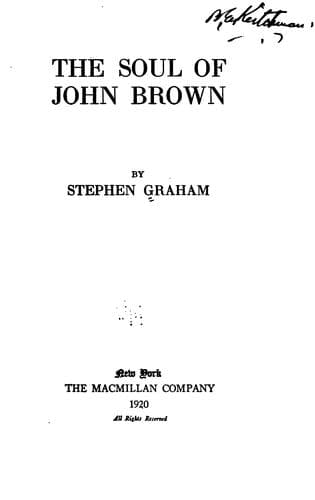
African Americans; United States -- Race relations
Although Charles Lynch of Virginia used to suspend British farmers by
their thumbs until they cried out _Liberty for ever!_ and lynching
has continued ever since, America is nevertheless at bottom free,
or at least was intended to be so by the idealists and politicians
who brought her forth. America is a living reproof of Europe, and it
has been generally conceived of as a land where men should suffer
no encroachment upon their personal liberty, where they should reap
duly the fruits of their labors, where no man should sap their rugged
independence or infringe upon the sovereign equality of their social
rights, where government should be entirely by consent of the governed,
not handed down from above as from superior beings or masters, but
controlled from below, from the broad base of toiling humanity.
The first discoverers were plunderers and seekers after barbaric
gold and gems, but her real pioneers were God-fearing men who laid
the foundations of modern American civilization by honest work and a
boundless belief in the development of free democracy. The institution
of slavery was therefore the thing which in theory was most abhorrent
to the American mind. It is a curious anomaly that a very short while
after the Declaration of Independence the land from which America
separated became free of slavery, and the British flag pre-eminently
the flag of freedom. But America, freed though she had become from
political interference on the part of Britain, nevertheless inherited
Negro slavery; and the economic prosperity of at least one-half of the
country was founded on the most hideous bondage in world history. Those
who had fled Europe to escape tyrants had themselves, under force of
circumstances, become tyrants.
Not that anyone willed slavery in America or designed to have it.
It was an economic accident. It was in America before most of the
Americans. The first Negro slaves were brought up the James River in
Virginia before the _Mayflower_ arrived, and as Negro orators say
to-day, “If being a long while in this country makes a good American,
we are the best Americans that there are.” Slavery had grown to vast
proportions by the time of the war against Britain. New America in
1783, standing on the threshold of the modern era, inherited a most
terrible burden in her millions of slaves. It was a burden that was
growing into the live flesh of America, and no one dared face at that
time the problem of getting free of it.
The actual American people as a whole were little responsible for
the institution of slavery. The pioneers hated and feared it. The
planters always condemned it in theory, and after the Emancipation of
1863 no one of any sense in the South has ever wished it back. Even
in those States where slavery took deepest root and showed its worst
characteristics, there was throughout the seventeenth and eighteenth
centuries a persistent resistance on the part of the colonists against
having black servile labor introduced.
Public-domain text, read in full here on John Shaqi.
Reviews
Reviews
No reviews yet
Be the first to share your thoughts on this work.
Join the Discussion
Join the discussion
Sign in to leave a comment or review.
Sign InorCreate an account