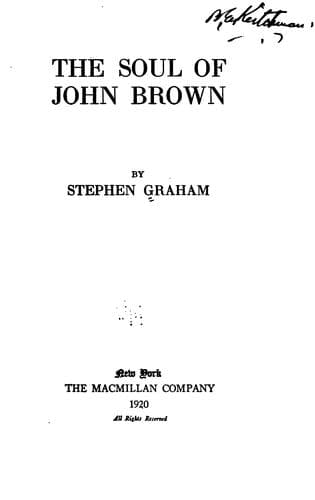
African Americans; United States -- Race relations
The lunch hour was remarkable for the swarms of men belched forth by
the works. A twenty-cent lunch was ready for all. Wives and mothers
also were allowed to come and bring food to supplement what was served
at the stands. Lunch over, the men formed into groups, and in some
places there were Bible discussions, in others sporting competitions.
Despite high wages, I noticed some Negroes going about picking up
crusts and putting them into paper bags, presumably to feed the
chickens with when they got home. My guide said this was due to the
“Save” propaganda which had been carried on. Y. M. C. A. work was very
much to the fore, an industrial “Y” having been financed by the owners
of the yard. I was told that a little while ago the company found
it difficult to keep the young Negro boys—the heaters and passers,
on whose work the rivetter depends, for one boy heats the rivet and
another passes it, and the rivetter strikes it home. They found so
little in the place to interest them that they drifted away from the
works. It was this that had determined the firm to embark on a program
of physical culture and games. There was also a Y. M. C. A. hut and its
usual appurtenances. A long list of evening classes was being arranged.
A large building had been promised to the “Y” if it made good.
I could not find any man who belonged to a genuine trade-union
affiliated to the American Federation of Labor, though most belonged
to “Colored People’s Brotherhoods.” The Whites with whom they worked,
and with whom they have upon occasion great rivetting competitions,
were presumably non-union also, but that is common; labor in America
is poorly organized, compared with labor in Great Britain. Almost the
whole of Negro labor is at present outside the recognized unions, and
for that reason can almost always be used to break strikes. This
is, of course, unfortunate for the Negro, who is thus branded as a
“blackleg” in addition to being black by nature, which was reproach
enough.
I met a strange character in the evening, one of the colored
organizers, a friend of the white men, and _in_ with the bosses of the
yards. He was possibly a descendant of the type of Negro who in slavery
days acted as agent for the slave merchants, and was to be found on the
West African shore lording it over the batches of poor savages who with
hands tied up were being hustled on to the slave ships. It used to be
a recognizable type. When they themselves were brought over to America
they became overseers or field drivers, and brutal enough they were to
their fellow men of color. To-day they are foremen or speeders up of
Negro gangs, or you find them under the auspices of “Welfare.”
Public-domain text, read in full here on John Shaqi.
Reviews
Reviews
No reviews yet
Be the first to share your thoughts on this work.
Join the Discussion
Join the discussion
Sign in to leave a comment or review.
Sign InorCreate an account