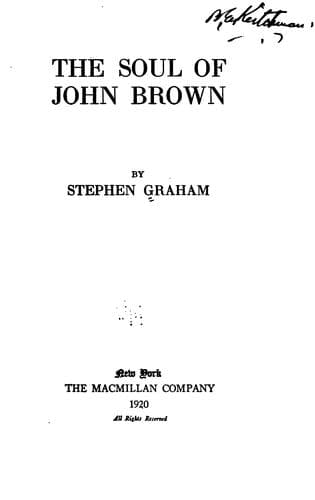
African Americans; United States -- Race relations
It was a grievance, and I thought a legitimate one, that whereas the
white schools were given good buildings with every latest convenience,
less was thought good enough for the Negro children. Though white
sympathizers with the ex-slave had been very generous in endowing Negro
education, their good work was more than neutralized by the Southern
local authorities, who held the point of view that education spoiled
the “nigger.” If it were not for the enthusiasm of the Negro teachers,
who carry on in any circumstances, it might easily have happened that
the colored people had a whole series of well-endowed universities and
colleges like Fisk and Hampton, but no elementary or secondary school
education worth the name.
Lack of good will toward the Negro thus expresses itself in many
ways; the failure to repair his roads, the failure to give him equal
facilities for education and self-improvement, and his exclusion from
the public libraries. The white man will not say “No” to grants of
money which give him handsome Carnegie library buildings for nothing
or will raise universities, even Negro universities, but he will not
fulfill his part of the unwritten contract—and honor all philanthropy
by indiscriminate good will.
After visiting the school I saw glimpses of Negro women at work in
characteristic places of earning a living. The management was always
very sensitive about strangers being present, so it was possible to
find out little about the conditions. One shop was full of girls
sewing ready-cut trousers on machines run by electricity. The trousers
were cut in Baltimore and sent down here to be sewn cheaply by local
colored labor. A Jew was in charge. A Negro woman was looking after
the “welfare” of the girls. Another was a tobacco factory, where girls
earned eleven dollars a week, working from 7:30 a. m. to 5:30 p. m.,
stripping tobacco leaf in airy and fragrant rooms. At piecework they
earned from six cents a pound.
I visited the publishing office of the _Journal and Guide_, where the
Negroes not only edit a paper but manufacture their own type and do
everything themselves—one of a hundred Negro newspapers published in
the United States. The average number of spelling errors in many of
these sheets seemed to be about three a paragraph, but that in no wise
renders them ridiculous or deters the pen of the ready writers. Negroes
have a passion for journalism which is out of proportion to their
present development and capacity.
As I came out of the publishing office with the editor we saw a hearse.
It was drawn by a motor, and it was a new idea to me, that of being
motored to one’s grave. The editor made a sign and the hearse stopped.
“Just a moment,” said he, and a lugubriously cloaked Ethiopian with
large, shining teeth stepped down.
“This is Undertaker Brown,” said the editor.
“Always at yo’ seyvice, sar,” said the undertaker. “Is yo’ thinking of
taking a ride with me?”
I said I was not meditating on that sad course yet.
Public-domain text, read in full here on John Shaqi.
Reviews
Reviews
No reviews yet
Be the first to share your thoughts on this work.
Join the Discussion
Join the discussion
Sign in to leave a comment or review.
Sign InorCreate an account