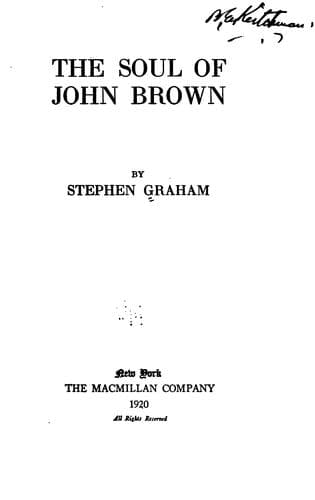
African Americans; United States -- Race relations
It is a great ordeal for a sensitive white person to take part in a
Negro revival or camp meeting. The emotional strain is tremendous.
Though it is difficult to move the Negro, once he is moved he can be
rapidly brought to a frenzy which surely has little enough to do with
the Christian religion. But even when he is not greatly moved it is
somewhat heart-searching for a white person present.
One day I went in at a chapel door. The building was full of Negroes;
every seat seemed taken. Perched high above the platform was a black
woman, all in black, with a large jet cross on her broad bosom. She was
reading from the First Book of Samuel in a great oracular voice which
never rose nor fell, but was like a pronouncement of eternal law. I was
taken right up to the front and given a seat under her throne. I knew
at once that there was likely to be an emotional storm in the audience.
It was throbbing on the heartstrings even as I listened to the reading,
and I wondered how I should combat it. After the Scripture the Lord’s
Prayer was said by a portentous Negro who had the frame of an African
warrior. When he went down on his knees he shook the beams of wood and
the seats. He prayed angrily, and clapped as he prayed, and interjected
remarks.
_Thy will be done!_ Yes, Lord, that’s it, that’s what we want,
certainly.
_Give us this day our daily bread!_ Yes, give us it (clap, clap, clap).
Give us our daily bread, Lord. Feed us! Feed us, Lord!
The congregation also on all hands interjected its remarks and clapped
and praised as the Lord’s Prayer went along.
The woman all in black was a famous mover of souls, and her sermon was
evidently the most looked-for religious excitement of the morning.
She was a plain woman with a powerful will, a great voice, and a rare
knowledge of the Bible. She preached from the text, “Saul hid himself
among the stuff.” First she told the story in a quiet voice and then
began to make the application. It was no use hiding from God, for He
would find you out.
So rousing were her simple words, and such was the atmosphere she was
begetting in the midst of her congregation, that I had to do everything
in my power to avoid breaking down under the influence and sobbing like
a child.
I went over in my mind the drama of “Macbeth,” and reconstructed
“Richard the Third,” and called to memory the speeches I had listened
to at the Bar dinner the night before, and what I had been doing during
the past week and month. But all the while I registered also in my
brain the whole of what the black priestess was saying.
Public-domain text, read in full here on John Shaqi.
Reviews
Reviews
No reviews yet
Be the first to share your thoughts on this work.
Join the Discussion
Join the discussion
Sign in to leave a comment or review.
Sign InorCreate an account