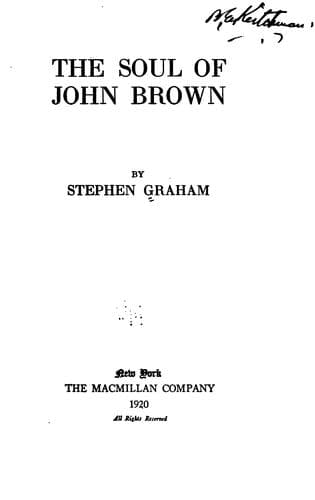
African Americans; United States -- Race relations
I never met a Negro who thought it humorous unless it were a member of
one sect telling of the “goings-on” in another. Each different race or
people seems to have its different characteristic religious expression.
When one has seen the exaltation of Copt and Arab in religion, when one
has heard the great choric voice of Russia at church, and the splendid,
purposeful faith of Teutonic hymns, one knows that a calm singing of
“Praise to the Holiest in the Height!” is not the only mode of praise.
There are fifty thousand ways of praising God, and every single one of
them is right.
So there is no call to chide the Negro for his excess. His ways are
part of the natural and Divine history of Man, and it is infinitely
worth while to consider them with an open and charitable mind. The
hysteria, the frenzy, of some meetings I have observed is not in the
white man. There is no use being appalled by it. It is the third part
which finishes the man downward, as St. John says in the desert.
“And after these emotional excitements they commit so many murders,”
said a Southern woman to me.
“If so, one must be upon one’s guard in the presence of a converted
man,” said I.
* * * * *
The foundation of the Negro’s great religious seriousness is to be
found in the Negro hymn or “spiritual.” These spirituals were before
there were Negro churches, before Christianity was actually allowed to
the slaves. That is why they are more often called plantation melodies.
They were sung in the twilight of the old plantations, and gave voice
to a great human sorrow and a great human need. They show that the
Negro has obtained access to the spiritual deeps, that he has a soul as
we have—a fact so often denied—and that he is capable of penetrating
the sublime. I listened very often to these songs. In several places
they were sung to honor a white visitor. I heard them rendered by
the Hampton Singers and lectured upon by Harry T. Burleigh, to whose
efforts in research the preservation of several are due. There is no
question of the excellence of them. They make a great appeal to all
people who have music in their souls.
Public-domain text, read in full here on John Shaqi.
Reviews
Reviews
No reviews yet
Be the first to share your thoughts on this work.
Join the Discussion
Join the discussion
Sign in to leave a comment or review.
Sign InorCreate an account