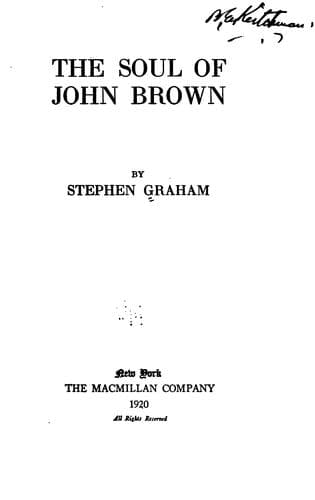
African Americans; United States -- Race relations
I passed through Eatonton, the birthplace of Joel Chandler Harris,
on my way to the sea. He taught us much about the Negro. In England
Brer Fox and Brer Rabbit have become as cherished as the toys of the
nursery. I think Uncle Remus meant as much to us as “Uncle Tom’s
Cabin.” The genial point of view and the genial books do as much to
help humanity as the strong and bitter ones. Both certainly have their
place. “Uncle Tom’s Cabin” stirred people out of a lazy attitude of
mind toward the Negro slaves, but in America it aggravated a bitterness
which no other book has been able to allay. The very intensity of the
white man’s thought about the Negro bodes ill for the future. The White
men of the North deliberately have made the effort to rear a Negro
_intelligentsia_. The idealists of the North said, “You shall go on”;
others said, “No, you shall stay as you were”; the clash of the two
wills lit up racial war, but the Negro has sided with the idealists
who sought to raise him, with the Friends of Pennsylvania and the
humanitarians of New England.
In the panic of Sherman’s approach the planters and their wives told
their slaves that the Yanks would flog them and burn them or put
them in the front of the battle, and drown the women and children
in the Ogeechee or the Chattahoochee. Many believed and fled with
their masters; others hid in the woods, but the rumor of salvation
was on the lips of most. The Southerner has a saying, “The nigger is
the greatest union in the country.” News indeed travels faster among
slaves and servants than among employers and masters. There was not
much hesitation when the army arrived. The Negroes saw and believed.
The incredulous were converted and the scared persuaded out of their
hiding places. All with one accord forgot their fear and then went to
the other extreme; that is, as far in credulity as their dull minds
had lodged in incredulity. The arrival of the victors gave rise to the
most extravagant hopes. The Negro had never reasoned about anything in
an informed way. He knew nothing of the world except the simplicity of
the plantation. He had on the one hand slavery, and on the other the
vague and vast idealism of Christian hymns; the melancholy of bondage
and the emotionalism of Evangelical religion. He did not think of New
York, London, Paris, St. Petersburg, of the workingmen’s movement, of
free thought, of political economy, but only of “de ole plantation,”
and then “de ribber.” From drab slavery he looked straight to Jordan
and the golden gates, and to a no-work, easy-going paradise happy as
the day is long, with God as Massa, and Mary and the Son to play with.
There were no between stages to which to aspire. They expected, as did
the Puritan churches about them, the huge combustion of the Last Day,
and they did not set much store by this world. Hence their exalted
state of mind following Sherman’s army. They were ready to shout
_Glory_ when the world was afire, and they displayed all the emotion
Public-domain text, read in full here on John Shaqi.
Reviews
Reviews
No reviews yet
Be the first to share your thoughts on this work.
Elsewhere in the archive
Join the Discussion
Join the discussion
Sign in to leave a comment or review.
Sign InorCreate an account