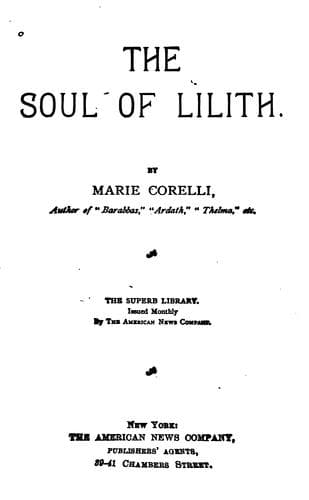
Elixir of life -- Fiction; Lilith (Semitic mythology) -- Fiction; Paranormal fiction
Here there was a brief and impressive silence. In that short interval,
and before the actor could resume his speech, a man entered the
theatre with noiseless step, and seated himself in a vacant stall of
the second row. A few heads were instinctively turned to look at him,
but in the semi-gloom of the auditorium his features could scarcely be
discerned, and Hamlet’s sad rich voice again compelled attention.
“Who would fardels bear,
To grunt and sweat under a weary life,
But that the dread of something after death,
The undiscovered country from whose bourne
No traveller returns, puzzles the will,
And makes us rather bear those ills we have
Than fly to others that we know not of?
Thus conscience does make cowards of us all;
And thus the native hue of resolution
Is sicklied o’er with the pale cast of thought;
And enterprises of great pith and moment,
With this regard, their currents turn awry
And lose the name of action.”
The scene went on to the despairing interview with Ophelia, which was
throughout performed with such splendid force and feeling as to awaken
a perfect hurricane of applause;--then the curtain went down, the
lights went up, the orchestra recommenced, and again inquisitive eyes
were turned towards the latest new-comer in the stalls who had made
his quiet entrance in the very midst of the great philosophical
soliloquy. He was immediately discovered to be a person well worth
observing; and observed he was accordingly, though he seemed quite
unaware of the attention he was attracting. Yet he was
singular-looking enough to excite a little curiosity even among modern
fashionable Londoners, who are accustomed to see all sorts of
eccentric beings, both male and female, æsthetic and commonplace; and
he was so distinctly separated from ordinary folk by his features and
bearing, that the rather loud whisper of an irrepressible young
American woman, “I’d give worlds to know who that man is!” was almost
pardonable under the circumstances. His skin was dark as a
mulatto’s,--yet smooth, and healthily coloured by the warm blood
flushing through the olive tint,--his eyes seemed black, but could
scarcely be seen on account of the extreme length and thickness of
their dark lashes,--the fine, rather scornful curve of his short upper
lip was partially hidden by a black moustache; and with all this
blackness and darkness about his face his hair, of which he seemed to
have an extraordinary profusion, was perfectly white. Not merely a
silvery white, but a white as pronounced as that of a bit of washed
fleece or newly-fallen snow. In looking at him it was impossible to
decide whether he was old or young,--because, though he carried no
wrinkles or other defacing marks of Time’s power to destroy, his
features wore an impress of such stern and deeply-resolved thought as
is seldom or never the heritage of those to whom youth still belongs.
Nevertheless, he seemed a long way off from being old,--so that,
Public-domain text, read in full here on John Shaqi.
Reviews
Reviews
No reviews yet
Be the first to share your thoughts on this work.
Join the Discussion
Join the discussion
Sign in to leave a comment or review.
Sign InorCreate an account