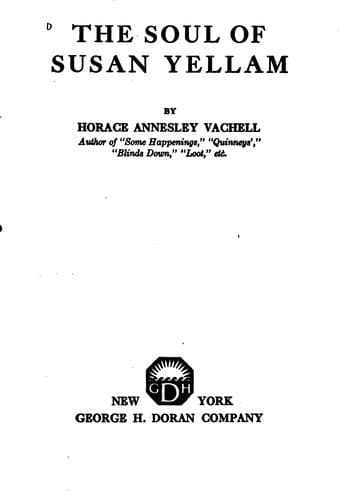
England -- Social life and customs -- 20th century -- Fiction; Villages -- England -- Fiction; World War, 1914-1918 -- Fiction
Soon afterwards he left the Vicarage, and, passing the church, paused a
moment. He went in and stood near the Font, staring at the Christmas
decorations and then at the Pomfret achievements emblazoned upon many of
the windows. The decorations served to remind the smallest child in his
congregation that another Child had been born into the world; the
achievements reminded the more sophisticated of the Pomfrets who had
died. The Child had been born to save others; the Pomfrets, many of them
worthy, God-fearing persons, had been mainly concerned in preserving
their own bodies and souls.
"He saved others; Himself He cannot save."
The wonderful line came into his mind, as his thoughts dwelt upon the
millions of seemingly righteous, respectable men and women bent on
saving their own souls, with but little regard for the souls of others.
The Salvation Army, so derided and condemned by Church and State when he
was a boy, had accomplished work which could not be ignored by priest
and prelate, work undertaken by labourers with no outshining
qualifications except faith in their ability to convince others, others
as humble in condition as themselves, who stood, for the most part,
beyond the pale of organised charity and richly-endowed religious
denominations.
Did this war, in relation to such thoughts, assume a new significance?
Could regeneration, reconstruction come from below, from the masses, for
example, out of which General Booth had enlisted his soldiers? Would a
privilege, the noblest in the world, the sacrosanct prerogative to touch
others to finer issues, emanate from the unprivileged? Hamlin could not
answer the question. Or, as seemed more likely, would light shine from
above, from a purified aristocracy, purged of self-interest by
sacrifice, proud and eager to remove intolerable burdens from their less
fortunate fellow-men? Or, a happier hypothesis than either, would the
complex problem be solved by co-operation of masses and classes made one
by sorrow and suffering, born anew through blood and tears? It might
well be so.
He left the church, and walked through the village. Much rain had
fallen. He noticed that the Avon was swollen, and ready to overflow its
banks. The wind blew cold upon his cheeks. The sun moved behind heavy
clouds ready to discharge vast accumulations of moisture. In short, a
raw, drizzling day, one of the last of an unhappy year.
When Hamlin reached the cottage, a small girl, who came in during the
morning to do house-work, the scrubbing and cleaning so dear to Susan,
told the Parson that Mrs. Yellam was upstairs. She believed that Mrs.
Alfred had passed a nice night. The baby was doing "lovely."
Susan appeared within a minute. A glance at Hamlin's face was enough for
her. In silence he took her hand and pressed it.
"You has news of Alferd, sir?"
Her voice was perfectly calm, calmer than his.
"I have a letter from his Commanding Officer. Sit down, and read it."
Public-domain text, read in full here on John Shaqi.
Reviews
Reviews
No reviews yet
Be the first to share your thoughts on this work.
Elsewhere in the archive
Join the Discussion
Join the discussion
Sign in to leave a comment or review.
Sign InorCreate an account