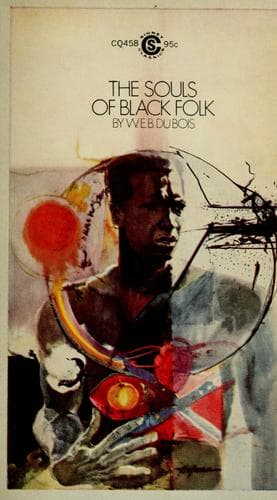
The Souls of Black FolkDu Bois, W. E. B. (William Edward Burghardt)
History
The Souls of Black Folk
Du Bois, W. E. B. (William Edward Burghardt)
African Americans
The war has naught to do with slaves, cried Congress, the President,
and the Nation; and yet no sooner had the armies, East and West,
penetrated Virginia and Tennessee than fugitive slaves appeared within
their lines. They came at night, when the flickering camp-fires shone
like vast unsteady stars along the black horizon: old men and thin,
with gray and tufted hair; women with frightened eyes, dragging
whimpering hungry children; men and girls, stalwart and gaunt,—a horde
of starving vagabonds, homeless, helpless, and pitiable, in their dark
distress. Two methods of treating these newcomers seemed equally
logical to opposite sorts of minds. Ben Butler, in Virginia, quickly
declared slave property contraband of war, and put the fugitives to
work; while Fremont, in Missouri, declared the slaves free under
martial law. Butler’s action was approved, but Fremont’s was hastily
countermanded, and his successor, Halleck, saw things differently.
“Hereafter,” he commanded, “no slaves should be allowed to come into
your lines at all; if any come without your knowledge, when owners call
for them deliver them.” Such a policy was difficult to enforce; some of
the black refugees declared themselves freemen, others showed that
their masters had deserted them, and still others were captured with
forts and plantations. Evidently, too, slaves were a source of strength
to the Confederacy, and were being used as laborers and producers.
“They constitute a military resource,” wrote Secretary Cameron, late in
1861; “and being such, that they should not be turned over to the enemy
is too plain to discuss.” So gradually the tone of the army chiefs
changed; Congress forbade the rendition of fugitives, and Butler’s
“contrabands” were welcomed as military laborers. This complicated
rather than solved the problem, for now the scattering fugitives became
a steady stream, which flowed faster as the armies marched.
Then the long-headed man with care-chiselled face who sat in the White
House saw the inevitable, and emancipated the slaves of rebels on New
Year’s, 1863. A month later Congress called earnestly for the Negro
soldiers whom the act of July, 1862, had half grudgingly allowed to
enlist. Thus the barriers were levelled and the deed was done. The
stream of fugitives swelled to a flood, and anxious army officers kept
inquiring: “What must be done with slaves, arriving almost daily? Are
we to find food and shelter for women and children?”
Public-domain text, read in full here on John Shaqi.
Reviews
Reviews
No reviews yet
Be the first to share your thoughts on this work.
Join the Discussion
Join the discussion
Sign in to leave a comment or review.
Sign InorCreate an account