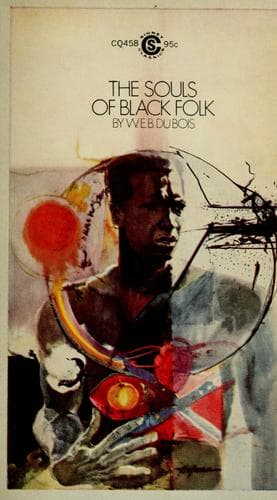
The Souls of Black FolkDu Bois, W. E. B. (William Edward Burghardt)
History
The Souls of Black Folk
Du Bois, W. E. B. (William Edward Burghardt)
African Americans
I have thus far sought to make clear the physical, economic, and
political relations of the Negroes and whites in the South, as I have
conceived them, including, for the reasons set forth, crime and
education. But after all that has been said on these more tangible
matters of human contact, there still remains a part essential to a
proper description of the South which it is difficult to describe or
fix in terms easily understood by strangers. It is, in fine, the
atmosphere of the land, the thought and feeling, the thousand and one
little actions which go to make up life. In any community or nation it
is these little things which are most elusive to the grasp and yet most
essential to any clear conception of the group life taken as a whole.
What is thus true of all communities is peculiarly true of the South,
where, outside of written history and outside of printed law, there has
been going on for a generation as deep a storm and stress of human
souls, as intense a ferment of feeling, as intricate a writhing of
spirit, as ever a people experienced. Within and without the sombre
veil of color vast social forces have been at work,—efforts for human
betterment, movements toward disintegration and despair, tragedies and
comedies in social and economic life, and a swaying and lifting and
sinking of human hearts which have made this land a land of mingled
sorrow and joy, of change and excitement and unrest.
The centre of this spiritual turmoil has ever been the millions of
black freedmen and their sons, whose destiny is so fatefully bound up
with that of the nation. And yet the casual observer visiting the South
sees at first little of this. He notes the growing frequency of dark
faces as he rides along,—but otherwise the days slip lazily on, the sun
shines, and this little world seems as happy and contented as other
worlds he has visited. Indeed, on the question of questions—the Negro
problem—he hears so little that there almost seems to be a conspiracy
of silence; the morning papers seldom mention it, and then usually in a
far-fetched academic way, and indeed almost every one seems to forget
and ignore the darker half of the land, until the astonished visitor is
inclined to ask if after all there IS any problem here. But if he
lingers long enough there comes the awakening: perhaps in a sudden
whirl of passion which leaves him gasping at its bitter intensity; more
likely in a gradually dawning sense of things he had not at first
noticed. Slowly but surely his eyes begin to catch the shadows of the
color-line: here he meets crowds of Negroes and whites; then he is
suddenly aware that he cannot discover a single dark face; or again at
the close of a day’s wandering he may find himself in some strange
assembly, where all faces are tinged brown or black, and where he has
the vague, uncomfortable feeling of the stranger. He realizes at last
that silently, resistlessly, the world about flows by him in two great
Public-domain text, read in full here on John Shaqi.
Reviews
Reviews
No reviews yet
Be the first to share your thoughts on this work.
Elsewhere in the archive
Join the Discussion
Join the discussion
Sign in to leave a comment or review.
Sign InorCreate an account