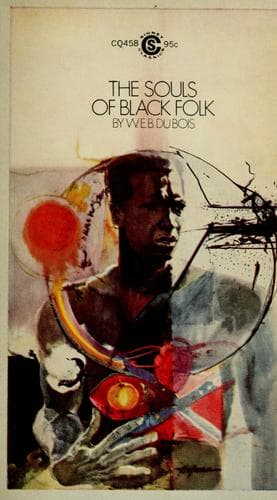
The Souls of Black FolkDu Bois, W. E. B. (William Edward Burghardt)
History
The Souls of Black Folk
Du Bois, W. E. B. (William Edward Burghardt)
African Americans
streams: they ripple on in the same sunshine, they approach and mingle
their waters in seeming carelessness,—then they divide and flow wide
apart. It is done quietly; no mistakes are made, or if one occurs, the
swift arm of the law and of public opinion swings down for a moment, as
when the other day a black man and a white woman were arrested for
talking together on Whitehall Street in Atlanta.
Now if one notices carefully one will see that between these two
worlds, despite much physical contact and daily intermingling, there is
almost no community of intellectual life or point of transference where
the thoughts and feelings of one race can come into direct contact and
sympathy with the thoughts and feelings of the other. Before and
directly after the war, when all the best of the Negroes were domestic
servants in the best of the white families, there were bonds of
intimacy, affection, and sometimes blood relationship, between the
races. They lived in the same home, shared in the family life, often
attended the same church, and talked and conversed with each other. But
the increasing civilization of the Negro since then has naturally meant
the development of higher classes: there are increasing numbers of
ministers, teachers, physicians, merchants, mechanics, and independent
farmers, who by nature and training are the aristocracy and leaders of
the blacks. Between them, however, and the best element of the whites,
there is little or no intellectual commerce. They go to separate
churches, they live in separate sections, they are strictly separated
in all public gatherings, they travel separately, and they are
beginning to read different papers and books. To most libraries,
lectures, concerts, and museums, Negroes are either not admitted at
all, or on terms peculiarly galling to the pride of the very classes
who might otherwise be attracted. The daily paper chronicles the doings
of the black world from afar with no great regard for accuracy; and so
on, throughout the category of means for intellectual
communication,—schools, conferences, efforts for social betterment, and
the like,—it is usually true that the very representatives of the two
races, who for mutual benefit and the welfare of the land ought to be
in complete understanding and sympathy, are so far strangers that one
side thinks all whites are narrow and prejudiced, and the other thinks
educated Negroes dangerous and insolent. Moreover, in a land where the
tyranny of public opinion and the intolerance of criticism is for
obvious historical reasons so strong as in the South, such a situation
is extremely difficult to correct. The white man, as well as the Negro,
is bound and barred by the color-line, and many a scheme of
friendliness and philanthropy, of broad-minded sympathy and generous
fellowship between the two has dropped still-born because some busybody
has forced the color-question to the front and brought the tremendous
force of unwritten law against the innovators.
Public-domain text, read in full here on John Shaqi.
Reviews
Reviews
No reviews yet
Be the first to share your thoughts on this work.
Elsewhere in the archive
Join the Discussion
Join the discussion
Sign in to leave a comment or review.
Sign InorCreate an account