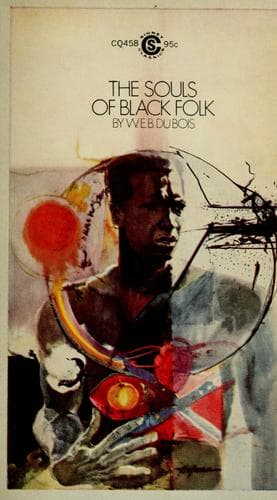
The Souls of Black FolkDu Bois, W. E. B. (William Edward Burghardt)
History
The Souls of Black Folk
Du Bois, W. E. B. (William Edward Burghardt)
African Americans
rather it was an adaptation and mingling of heathen rites among the
members of each plantation, and roughly designated as Voodooism.
Association with the masters, missionary effort and motives of
expediency gave these rites an early veneer of Christianity, and after
the lapse of many generations the Negro church became Christian.
Two characteristic things must be noticed in regard to the church.
First, it became almost entirely Baptist and Methodist in faith;
secondly, as a social institution it antedated by many decades the
monogamic Negro home. From the very circumstances of its beginning, the
church was confined to the plantation, and consisted primarily of a
series of disconnected units; although, later on, some freedom of
movement was allowed, still this geographical limitation was always
important and was one cause of the spread of the decentralized and
democratic Baptist faith among the slaves. At the same time, the
visible rite of baptism appealed strongly to their mystic temperament.
To-day the Baptist Church is still largest in membership among Negroes,
and has a million and a half communicants. Next in popularity came the
churches organized in connection with the white neighboring churches,
chiefly Baptist and Methodist, with a few Episcopalian and others. The
Methodists still form the second greatest denomination, with nearly a
million members. The faith of these two leading denominations was more
suited to the slave church from the prominence they gave to religious
feeling and fervor. The Negro membership in other denominations has
always been small and relatively unimportant, although the
Episcopalians and Presbyterians are gaining among the more intelligent
classes to-day, and the Catholic Church is making headway in certain
sections. After Emancipation, and still earlier in the North, the Negro
churches largely severed such affiliations as they had had with the
white churches, either by choice or by compulsion. The Baptist churches
became independent, but the Methodists were compelled early to unite
for purposes of episcopal government. This gave rise to the great
African Methodist Church, the greatest Negro organization in the world,
to the Zion Church and the Colored Methodist, and to the black
conferences and churches in this and other denominations.
Public-domain text, read in full here on John Shaqi.
Reviews
Reviews
No reviews yet
Be the first to share your thoughts on this work.
Elsewhere in the archive
Join the Discussion
Join the discussion
Sign in to leave a comment or review.
Sign InorCreate an account