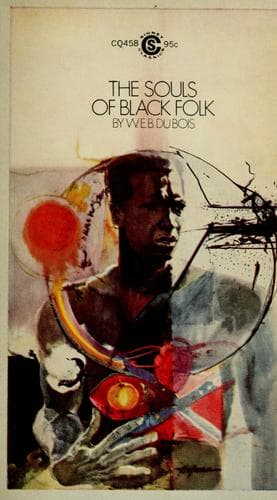
The Souls of Black FolkDu Bois, W. E. B. (William Edward Burghardt)
History
The Souls of Black Folk
Du Bois, W. E. B. (William Edward Burghardt)
African Americans
The second fact noted, namely, that the Negro church antedates the
Negro home, leads to an explanation of much that is paradoxical in this
communistic institution and in the morals of its members. But
especially it leads us to regard this institution as peculiarly the
expression of the inner ethical life of a people in a sense seldom true
elsewhere. Let us turn, then, from the outer physical development of
the church to the more important inner ethical life of the people who
compose it. The Negro has already been pointed out many times as a
religious animal,—a being of that deep emotional nature which turns
instinctively toward the supernatural. Endowed with a rich tropical
imagination and a keen, delicate appreciation of Nature, the
transplanted African lived in a world animate with gods and devils,
elves and witches; full of strange influences,—of Good to be implored,
of Evil to be propitiated. Slavery, then, was to him the dark triumph
of Evil over him. All the hateful powers of the Under-world were
striving against him, and a spirit of revolt and revenge filled his
heart. He called up all the resources of heathenism to aid,—exorcism
and witch-craft, the mysterious Obi worship with its barbarious rites,
spells, and blood-sacrifice even, now and then, of human victims. Weird
midnight orgies and mystic conjurations were invoked, the witch-woman
and the voodoo-priest became the centre of Negro group life, and that
vein of vague superstition which characterizes the unlettered Negro
even to-day was deepened and strengthened.
In spite, however, of such success as that of the fierce Maroons, the
Danish blacks, and others, the spirit of revolt gradually died away
under the untiring energy and superior strength of the slave masters.
By the middle of the eighteenth century the black slave had sunk, with
hushed murmurs, to his place at the bottom of a new economic system,
and was unconsciously ripe for a new philosophy of life. Nothing suited
his condition then better than the doctrines of passive submission
embodied in the newly learned Christianity. Slave masters early
realized this, and cheerfully aided religious propaganda within certain
bounds. The long system of repression and degradation of the Negro
tended to emphasize the elements of his character which made him a
valuable chattel: courtesy became humility, moral strength degenerated
into submission, and the exquisite native appreciation of the beautiful
became an infinite capacity for dumb suffering. The Negro, losing the
joy of this world, eagerly seized upon the offered conceptions of the
next; the avenging Spirit of the Lord enjoining patience in this world,
under sorrow and tribulation until the Great Day when He should lead
His dark children home,—this became his comforting dream. His preacher
repeated the prophecy, and his bards sang,—
“Children, we all shall be free
When the Lord shall appear!”
Public-domain text, read in full here on John Shaqi.
Reviews
Reviews
No reviews yet
Be the first to share your thoughts on this work.
Elsewhere in the archive
Join the Discussion
Join the discussion
Sign in to leave a comment or review.
Sign InorCreate an account