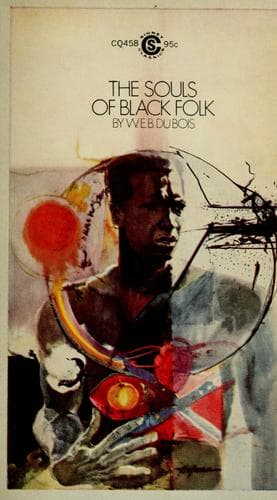
The Souls of Black FolkDu Bois, W. E. B. (William Edward Burghardt)
History
The Souls of Black Folk
Du Bois, W. E. B. (William Edward Burghardt)
African Americans
This deep religious fatalism, painted so beautifully in “Uncle Tom,”
came soon to breed, as all fatalistic faiths will, the sensualist side
by side with the martyr. Under the lax moral life of the plantation,
where marriage was a farce, laziness a virtue, and property a theft, a
religion of resignation and submission degenerated easily, in less
strenuous minds, into a philosophy of indulgence and crime. Many of the
worst characteristics of the Negro masses of to-day had their seed in
this period of the slave’s ethical growth. Here it was that the Home
was ruined under the very shadow of the Church, white and black; here
habits of shiftlessness took root, and sullen hopelessness replaced
hopeful strife.
With the beginning of the abolition movement and the gradual growth of
a class of free Negroes came a change. We often neglect the influence
of the freedman before the war, because of the paucity of his numbers
and the small weight he had in the history of the nation. But we must
not forget that his chief influence was internal,—was exerted on the
black world; and that there he was the ethical and social leader.
Huddled as he was in a few centres like Philadelphia, New York, and New
Orleans, the masses of the freedmen sank into poverty and listlessness;
but not all of them. The free Negro leader early arose and his chief
characteristic was intense earnestness and deep feeling on the slavery
question. Freedom became to him a real thing and not a dream. His
religion became darker and more intense, and into his ethics crept a
note of revenge, into his songs a day of reckoning close at hand. The
“Coming of the Lord” swept this side of Death, and came to be a thing
to be hoped for in this day. Through fugitive slaves and irrepressible
discussion this desire for freedom seized the black millions still in
bondage, and became their one ideal of life. The black bards caught new
notes, and sometimes even dared to sing,—
“O Freedom, O Freedom, O Freedom over me!
Before I’ll be a slave
I’ll be buried in my grave,
And go home to my Lord
And be free.”
For fifty years Negro religion thus transformed itself and identified
itself with the dream of Abolition, until that which was a radical fad
in the white North and an anarchistic plot in the white South had
become a religion to the black world. Thus, when Emancipation finally
came, it seemed to the freedman a literal Coming of the Lord. His
fervid imagination was stirred as never before, by the tramp of armies,
the blood and dust of battle, and the wail and whirl of social
upheaval. He stood dumb and motionless before the whirlwind: what had
he to do with it? Was it not the Lord’s doing, and marvellous in his
eyes? Joyed and bewildered with what came, he stood awaiting new
wonders till the inevitable Age of Reaction swept over the nation and
brought the crisis of to-day.
Public-domain text, read in full here on John Shaqi.
Reviews
Reviews
No reviews yet
Be the first to share your thoughts on this work.
Elsewhere in the archive
Join the Discussion
Join the discussion
Sign in to leave a comment or review.
Sign InorCreate an account