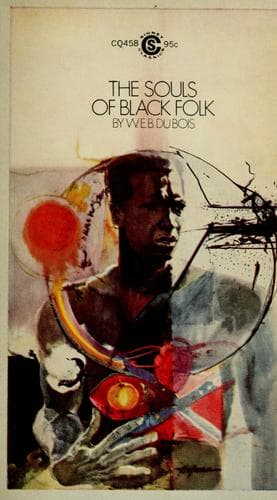
The Souls of Black FolkDu Bois, W. E. B. (William Edward Burghardt)
History
The Souls of Black Folk
Du Bois, W. E. B. (William Edward Burghardt)
African Americans
To-day the two groups of Negroes, the one in the North, the other in
the South, represent these divergent ethical tendencies, the first
tending toward radicalism, the other toward hypocritical compromise. It
is no idle regret with which the white South mourns the loss of the
old-time Negro,—the frank, honest, simple old servant who stood for the
earlier religious age of submission and humility. With all his laziness
and lack of many elements of true manhood, he was at least
open-hearted, faithful, and sincere. To-day he is gone, but who is to
blame for his going? Is it not those very persons who mourn for him? Is
it not the tendency, born of Reconstruction and Reaction, to found a
society on lawlessness and deception, to tamper with the moral fibre of
a naturally honest and straightforward people until the whites threaten
to become ungovernable tyrants and the blacks criminals and hypocrites?
Deception is the natural defence of the weak against the strong, and
the South used it for many years against its conquerors; to-day it must
be prepared to see its black proletariat turn that same two-edged
weapon against itself. And how natural this is! The death of Denmark
Vesey and Nat Turner proved long since to the Negro the present
hopelessness of physical defence. Political defence is becoming less
and less available, and economic defence is still only partially
effective. But there is a patent defence at hand,—the defence of
deception and flattery, of cajoling and lying. It is the same defence
which peasants of the Middle Age used and which left its stamp on their
character for centuries. To-day the young Negro of the South who would
succeed cannot be frank and outspoken, honest and self-assertive, but
rather he is daily tempted to be silent and wary, politic and sly; he
must flatter and be pleasant, endure petty insults with a smile, shut
his eyes to wrong; in too many cases he sees positive personal
advantage in deception and lying. His real thoughts, his real
aspirations, must be guarded in whispers; he must not criticise, he
must not complain. Patience, humility, and adroitness must, in these
growing black youth, replace impulse, manliness, and courage. With this
sacrifice there is an economic opening, and perhaps peace and some
prosperity. Without this there is riot, migration, or crime. Nor is
this situation peculiar to the Southern United States, is it not rather
the only method by which undeveloped races have gained the right to
share modern culture? The price of culture is a Lie.
Public-domain text, read in full here on John Shaqi.
Reviews
Reviews
No reviews yet
Be the first to share your thoughts on this work.
Elsewhere in the archive
Join the Discussion
Join the discussion
Sign in to leave a comment or review.
Sign InorCreate an account