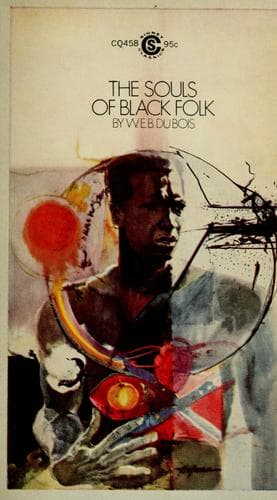
The Souls of Black FolkDu Bois, W. E. B. (William Edward Burghardt)
History
The Souls of Black Folk
Du Bois, W. E. B. (William Edward Burghardt)
African Americans
Strange temptation for a child, you may think; and yet in this wide
land to-day a thousand thousand dark children brood before this same
temptation, and feel its cold and shuddering arms. For them, perhaps,
some one will some day lift the Veil,—will come tenderly and cheerily
into those sad little lives and brush the brooding hate away, just as
Beriah Green strode in upon the life of Alexander Crummell. And before
the bluff, kind-hearted man the shadow seemed less dark. Beriah Green
had a school in Oneida County, New York, with a score of mischievous
boys. “I’m going to bring a black boy here to educate,” said Beriah
Green, as only a crank and an abolitionist would have dared to say.
“Oho!” laughed the boys. “Ye-es,” said his wife; and Alexander came.
Once before, the black boy had sought a school, had travelled, cold and
hungry, four hundred miles up into free New Hampshire, to Canaan. But
the godly farmers hitched ninety yoke of oxen to the abolition
schoolhouse and dragged it into the middle of the swamp. The black boy
trudged away.
The nineteenth was the first century of human sympathy,—the age when
half wonderingly we began to descry in others that transfigured spark
of divinity which we call Myself; when clodhoppers and peasants, and
tramps and thieves, and millionaires and—sometimes—Negroes, became
throbbing souls whose warm pulsing life touched us so nearly that we
half gasped with surprise, crying, “Thou too! Hast Thou seen Sorrow and
the dull waters of Hopelessness? Hast Thou known Life?” And then all
helplessly we peered into those Other-worlds, and wailed, “O World of
Worlds, how shall man make you one?”
So in that little Oneida school there came to those schoolboys a
revelation of thought and longing beneath one black skin, of which they
had not dreamed before. And to the lonely boy came a new dawn of
sympathy and inspiration. The shadowy, formless thing—the temptation of
Hate, that hovered between him and the world—grew fainter and less
sinister. It did not wholly fade away, but diffused itself and lingered
thick at the edges. Through it the child now first saw the blue and
gold of life,—the sun-swept road that ran ’twixt heaven and earth until
in one far-off wan wavering line they met and kissed. A vision of life
came to the growing boy,—mystic, wonderful. He raised his head,
stretched himself, breathed deep of the fresh new air. Yonder, behind
the forests, he heard strange sounds; then glinting through the trees
he saw, far, far away, the bronzed hosts of a nation calling,—calling
faintly, calling loudly. He heard the hateful clank of their chains; he
felt them cringe and grovel, and there rose within him a protest and a
prophecy. And he girded himself to walk down the world.
Public-domain text, read in full here on John Shaqi.
Reviews
Reviews
No reviews yet
Be the first to share your thoughts on this work.
Elsewhere in the archive
Join the Discussion
Join the discussion
Sign in to leave a comment or review.
Sign InorCreate an account