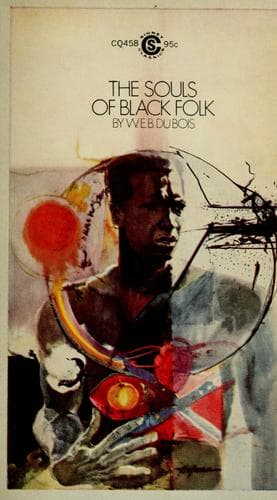
The Souls of Black FolkDu Bois, W. E. B. (William Edward Burghardt)
History
The Souls of Black Folk
Du Bois, W. E. B. (William Edward Burghardt)
African Americans
A voice and vision called him to be a priest,—a seer to lead the
uncalled out of the house of bondage. He saw the headless host turn
toward him like the whirling of mad waters,—he stretched forth his
hands eagerly, and then, even as he stretched them, suddenly there
swept across the vision the temptation of Despair.
They were not wicked men,—the problem of life is not the problem of the
wicked,—they were calm, good men, Bishops of the Apostolic Church of
God, and strove toward righteousness. They said slowly, “It is all very
natural—it is even commendable; but the General Theological Seminary of
the Episcopal Church cannot admit a Negro.” And when that thin,
half-grotesque figure still haunted their doors, they put their hands
kindly, half sorrowfully, on his shoulders, and said, “Now,—of course,
we—we know how _you_ feel about it; but you see it is impossible,—that
is—well—it is premature. Sometime, we trust—sincerely trust—all such
distinctions will fade away; but now the world is as it is.”
This was the temptation of Despair; and the young man fought it
doggedly. Like some grave shadow he flitted by those halls, pleading,
arguing, half angrily demanding admittance, until there came the final
_No;_ until men hustled the disturber away, marked him as foolish,
unreasonable, and injudicious, a vain rebel against God’s law. And then
from that Vision Splendid all the glory faded slowly away, and left an
earth gray and stern rolling on beneath a dark despair. Even the kind
hands that stretched themselves toward him from out the depths of that
dull morning seemed but parts of the purple shadows. He saw them
coldly, and asked, “Why should I strive by special grace when the way
of the world is closed to me?” All gently yet, the hands urged him
on,—the hands of young John Jay, that daring father’s daring son; the
hands of the good folk of Boston, that free city. And yet, with a way
to the priesthood of the Church open at last before him, the cloud
lingered there; and even when in old St. Paul’s the venerable Bishop
raised his white arms above the Negro deacon—even then the burden had
not lifted from that heart, for there had passed a glory from the
earth.
And yet the fire through which Alexander Crummell went did not burn in
vain. Slowly and more soberly he took up again his plan of life. More
critically he studied the situation. Deep down below the slavery and
servitude of the Negro people he saw their fatal weaknesses, which long
years of mistreatment had emphasized. The dearth of strong moral
character, of unbending righteousness, he felt, was their great
shortcoming, and here he would begin. He would gather the best of his
people into some little Episcopal chapel and there lead, teach, and
inspire them, till the leaven spread, till the children grew, till the
world hearkened, till—till—and then across his dream gleamed some faint
after-glow of that first fair vision of youth—only an after-glow, for
there had passed a glory from the earth.
Public-domain text, read in full here on John Shaqi.
Reviews
Reviews
No reviews yet
Be the first to share your thoughts on this work.
Elsewhere in the archive
Join the Discussion
Join the discussion
Sign in to leave a comment or review.
Sign InorCreate an account