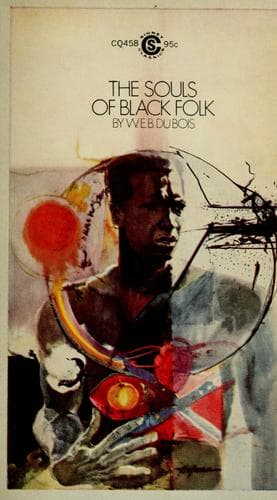
The Souls of Black FolkDu Bois, W. E. B. (William Edward Burghardt)
History
The Souls of Black Folk
Du Bois, W. E. B. (William Edward Burghardt)
African Americans
Three characteristic things one might have seen in Sherman’s raid
through Georgia, which threw the new situation in shadowy relief: the
Conqueror, the Conquered, and the Negro. Some see all significance in
the grim front of the destroyer, and some in the bitter sufferers of
the Lost Cause. But to me neither soldier nor fugitive speaks with so
deep a meaning as that dark human cloud that clung like remorse on the
rear of those swift columns, swelling at times to half their size,
almost engulfing and choking them. In vain were they ordered back, in
vain were bridges hewn from beneath their feet; on they trudged and
writhed and surged, until they rolled into Savannah, a starved and
naked horde of tens of thousands. There too came the characteristic
military remedy: “The islands from Charleston south, the abandoned
rice-fields along the rivers for thirty miles back from the sea, and
the country bordering the St. John’s River, Florida, are reserved and
set apart for the settlement of Negroes now made free by act of war.”
So read the celebrated “Field-order Number Fifteen.”
All these experiments, orders, and systems were bound to attract and
perplex the government and the nation. Directly after the Emancipation
Proclamation, Representative Eliot had introduced a bill creating a
Bureau of Emancipation; but it was never reported. The following June a
committee of inquiry, appointed by the Secretary of War, reported in
favor of a temporary bureau for the “improvement, protection, and
employment of refugee freedmen,” on much the same lines as were
afterwards followed. Petitions came in to President Lincoln from
distinguished citizens and organizations, strongly urging a
comprehensive and unified plan of dealing with the freedmen, under a
bureau which should be “charged with the study of plans and execution
of measures for easily guiding, and in every way judiciously and
humanely aiding, the passage of our emancipated and yet to be
emancipated blacks from the old condition of forced labor to their new
state of voluntary industry.”
Some half-hearted steps were taken to accomplish this, in part, by
putting the whole matter again in charge of the special Treasury
agents. Laws of 1863 and 1864 directed them to take charge of and lease
abandoned lands for periods not exceeding twelve months, and to
“provide in such leases, or otherwise, for the employment and general
welfare” of the freedmen. Most of the army officers greeted this as a
welcome relief from perplexing “Negro affairs,” and Secretary
Fessenden, July 29, 1864, issued an excellent system of regulations,
which were afterward closely followed by General Howard. Under Treasury
agents, large quantities of land were leased in the Mississippi Valley,
and many Negroes were employed; but in August, 1864, the new
regulations were suspended for reasons of “public policy,” and the army
was again in control.
Public-domain text, read in full here on John Shaqi.
Reviews
Reviews
No reviews yet
Be the first to share your thoughts on this work.
Join the Discussion
Join the discussion
Sign in to leave a comment or review.
Sign InorCreate an account