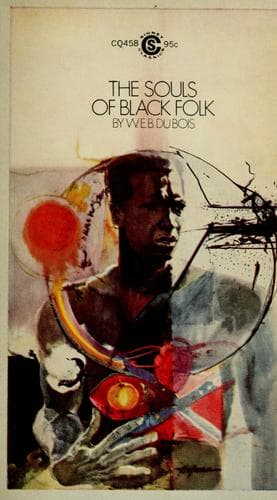
The Souls of Black FolkDu Bois, W. E. B. (William Edward Burghardt)
History
The Souls of Black Folk
Du Bois, W. E. B. (William Edward Burghardt)
African Americans
Bishop Onderdonk lived at the head of six white steps,—corpulent,
red-faced, and the author of several thrilling tracts on Apostolic
Succession. It was after dinner, and the Bishop had settled himself for
a pleasant season of contemplation, when the bell must needs ring, and
there must burst in upon the Bishop a letter and a thin, ungainly
Negro. Bishop Onderdonk read the letter hastily and frowned.
Fortunately, his mind was already clear on this point; and he cleared
his brow and looked at Crummell. Then he said, slowly and impressively:
“I will receive you into this diocese on one condition: no Negro priest
can sit in my church convention, and no Negro church must ask for
representation there.”
I sometimes fancy I can see that tableau: the frail black figure,
nervously twitching his hat before the massive abdomen of Bishop
Onderdonk; his threadbare coat thrown against the dark woodwork of the
bookcases, where Fox’s “Lives of the Martyrs” nestled happily beside
“The Whole Duty of Man.” I seem to see the wide eyes of the Negro
wander past the Bishop’s broadcloth to where the swinging glass doors
of the cabinet glow in the sunlight. A little blue fly is trying to
cross the yawning keyhole. He marches briskly up to it, peers into the
chasm in a surprised sort of way, and rubs his feelers reflectively;
then he essays its depths, and, finding it bottomless, draws back
again. The dark-faced priest finds himself wondering if the fly too has
faced its Valley of Humiliation, and if it will plunge into it,—when
lo! it spreads its tiny wings and buzzes merrily across, leaving the
watcher wingless and alone.
Then the full weight of his burden fell upon him. The rich walls
wheeled away, and before him lay the cold rough moor winding on through
life, cut in twain by one thick granite ridge,—here, the Valley of
Humiliation; yonder, the Valley of the Shadow of Death. And I know not
which be darker,—no, not I. But this I know: in yonder Vale of the
Humble stand to-day a million swarthy men, who willingly would
“. . . bear the whips and scorns of time,
The oppressor’s wrong, the proud man’s contumely,
The pangs of despised love, the law’s delay,
The insolence of office, and the spurns
That patient merit of the unworthy takes,”—
Public-domain text, read in full here on John Shaqi.
Reviews
Reviews
No reviews yet
Be the first to share your thoughts on this work.
Elsewhere in the archive
Join the Discussion
Join the discussion
Sign in to leave a comment or review.
Sign InorCreate an account