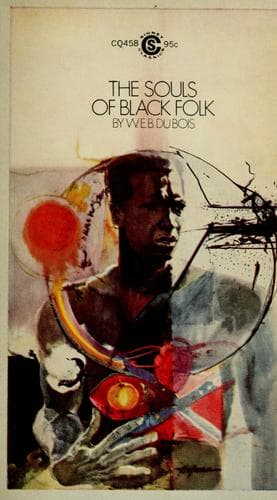
The Souls of Black FolkDu Bois, W. E. B. (William Edward Burghardt)
History
The Souls of Black Folk
Du Bois, W. E. B. (William Edward Burghardt)
African Americans
But Alexander Crummell it gave back. Out of the temptation of Hate, and
burned by the fire of Despair, triumphant over Doubt, and steeled by
Sacrifice against Humiliation, he turned at last home across the
waters, humble and strong, gentle and determined. He bent to all the
gibes and prejudices, to all hatred and discrimination, with that rare
courtesy which is the armor of pure souls. He fought among his own, the
low, the grasping, and the wicked, with that unbending righteousness
which is the sword of the just. He never faltered, he seldom
complained; he simply worked, inspiring the young, rebuking the old,
helping the weak, guiding the strong.
So he grew, and brought within his wide influence all that was best of
those who walk within the Veil. They who live without knew not nor
dreamed of that full power within, that mighty inspiration which the
dull gauze of caste decreed that most men should not know. And now that
he is gone, I sweep the Veil away and cry, Lo! the soul to whose dear
memory I bring this little tribute. I can see his face still, dark and
heavy-lined beneath his snowy hair; lighting and shading, now with
inspiration for the future, now in innocent pain at some human
wickedness, now with sorrow at some hard memory from the past. The more
I met Alexander Crummell, the more I felt how much that world was
losing which knew so little of him. In another age he might have sat
among the elders of the land in purple-bordered toga; in another
country mothers might have sung him to the cradles.
He did his work,—he did it nobly and well; and yet I sorrow that here
he worked alone, with so little human sympathy. His name to-day, in
this broad land, means little, and comes to fifty million ears laden
with no incense of memory or emulation. And herein lies the tragedy of
the age: not that men are poor,—all men know something of poverty; not
that men are wicked,—who is good? not that men are ignorant,—what is
Truth? Nay, but that men know so little of men.
He sat one morning gazing toward the sea. He smiled and said, “The gate
is rusty on the hinges.” That night at star-rise a wind came moaning
out of the west to blow the gate ajar, and then the soul I loved fled
like a flame across the Seas, and in its seat sat Death.
I wonder where he is to-day? I wonder if in that dim world beyond, as
he came gliding in, there rose on some wan throne a King,—a dark and
pierced Jew, who knows the writhings of the earthly damned, saying, as
he laid those heart-wrung talents down, “Well done!” while round about
the morning stars sat singing.
XIII.
Of the Coming of John
What bring they ’neath the midnight,
Beside the River-sea?
They bring the human heart wherein
No nightly calm can be;
That droppeth never with the wind,
Nor drieth with the dew;
O calm it, God; thy calm is broad
To cover spirits too.
The river floweth on.
MRS. BROWNING.
[Illustration]
Public-domain text, read in full here on John Shaqi.
Reviews
Reviews
No reviews yet
Be the first to share your thoughts on this work.
Elsewhere in the archive
Join the Discussion
Join the discussion
Sign in to leave a comment or review.
Sign InorCreate an account