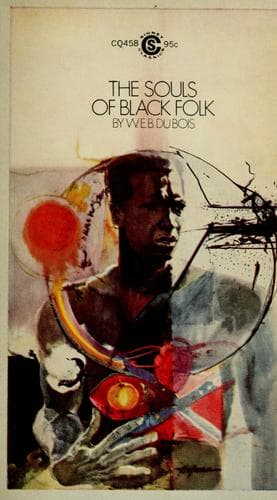
The Souls of Black FolkDu Bois, W. E. B. (William Edward Burghardt)
History
The Souls of Black Folk
Du Bois, W. E. B. (William Edward Burghardt)
African Americans
Carlisle Street runs westward from the centre of Johnstown, across a
great black bridge, down a hill and up again, by little shops and
meat-markets, past single-storied homes, until suddenly it stops
against a wide green lawn. It is a broad, restful place, with two large
buildings outlined against the west. When at evening the winds come
swelling from the east, and the great pall of the city’s smoke hangs
wearily above the valley, then the red west glows like a dreamland down
Carlisle Street, and, at the tolling of the supper-bell, throws the
passing forms of students in dark silhouette against the sky. Tall and
black, they move slowly by, and seem in the sinister light to flit
before the city like dim warning ghosts. Perhaps they are; for this is
Wells Institute, and these black students have few dealings with the
white city below.
And if you will notice, night after night, there is one dark form that
ever hurries last and late toward the twinkling lights of Swain
Hall,—for Jones is never on time. A long, straggling fellow he is,
brown and hard-haired, who seems to be growing straight out of his
clothes, and walks with a half-apologetic roll. He used perpetually to
set the quiet dining-room into waves of merriment, as he stole to his
place after the bell had tapped for prayers; he seemed so perfectly
awkward. And yet one glance at his face made one forgive him much,—that
broad, good-natured smile in which lay no bit of art or artifice, but
seemed just bubbling good-nature and genuine satisfaction with the
world.
He came to us from Altamaha, away down there beneath the gnarled oaks
of Southeastern Georgia, where the sea croons to the sands and the
sands listen till they sink half drowned beneath the waters, rising
only here and there in long, low islands. The white folk of Altamaha
voted John a good boy,—fine plough-hand, good in the rice-fields, handy
everywhere, and always good-natured and respectful. But they shook
their heads when his mother wanted to send him off to school. “It’ll
spoil him,—ruin him,” they said; and they talked as though they knew.
But full half the black folk followed him proudly to the station, and
carried his queer little trunk and many bundles. And there they shook
and shook hands, and the girls kissed him shyly and the boys clapped
him on the back. So the train came, and he pinched his little sister
lovingly, and put his great arms about his mother’s neck, and then was
away with a puff and a roar into the great yellow world that flamed and
flared about the doubtful pilgrim. Up the coast they hurried, past the
squares and palmettos of Savannah, through the cotton-fields and
through the weary night, to Millville, and came with the morning to the
noise and bustle of Johnstown.
Public-domain text, read in full here on John Shaqi.
Reviews
Reviews
No reviews yet
Be the first to share your thoughts on this work.
Elsewhere in the archive
Join the Discussion
Join the discussion
Sign in to leave a comment or review.
Sign InorCreate an account