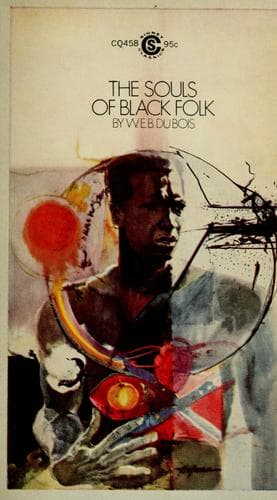
The Souls of Black FolkDu Bois, W. E. B. (William Edward Burghardt)
History
The Souls of Black Folk
Du Bois, W. E. B. (William Edward Burghardt)
African Americans
And they that stood behind, that morning in Altamaha, and watched the
train as it noisily bore playmate and brother and son away to the
world, had thereafter one ever-recurring word,—“When John comes.” Then
what parties were to be, and what speakings in the churches; what new
furniture in the front room,—perhaps even a new front room; and there
would be a new schoolhouse, with John as teacher; and then perhaps a
big wedding; all this and more—when John comes. But the white people
shook their heads.
At first he was coming at Christmas-time,—but the vacation proved too
short; and then, the next summer,—but times were hard and schooling
costly, and so, instead, he worked in Johnstown. And so it drifted to
the next summer, and the next,—till playmates scattered, and mother
grew gray, and sister went up to the Judge’s kitchen to work. And still
the legend lingered,—“When John comes.”
Up at the Judge’s they rather liked this refrain; for they too had a
John—a fair-haired, smooth-faced boy, who had played many a long
summer’s day to its close with his darker namesake. “Yes, sir! John is
at Princeton, sir,” said the broad-shouldered gray-haired Judge every
morning as he marched down to the post-office. “Showing the Yankees
what a Southern gentleman can do,” he added; and strode home again with
his letters and papers. Up at the great pillared house they lingered
long over the Princeton letter,—the Judge and his frail wife, his
sister and growing daughters. “It’ll make a man of him,” said the
Judge, “college is the place.” And then he asked the shy little
waitress, “Well, Jennie, how’s your John?” and added reflectively, “Too
bad, too bad your mother sent him off—it will spoil him.” And the
waitress wondered.
Thus in the far-away Southern village the world lay waiting, half
consciously, the coming of two young men, and dreamed in an
inarticulate way of new things that would be done and new thoughts that
all would think. And yet it was singular that few thought of two
Johns,—for the black folk thought of one John, and he was black; and
the white folk thought of another John, and he was white. And neither
world thought the other world’s thought, save with a vague unrest.
Up in Johnstown, at the Institute, we were long puzzled at the case of
John Jones. For a long time the clay seemed unfit for any sort of
moulding. He was loud and boisterous, always laughing and singing, and
never able to work consecutively at anything. He did not know how to
study; he had no idea of thoroughness; and with his tardiness,
carelessness, and appalling good-humor, we were sore perplexed. One
night we sat in faculty-meeting, worried and serious; for Jones was in
trouble again. This last escapade was too much, and so we solemnly
voted “that Jones, on account of repeated disorder and inattention to
work, be suspended for the rest of the term.”
Public-domain text, read in full here on John Shaqi.
Reviews
Reviews
No reviews yet
Be the first to share your thoughts on this work.
Elsewhere in the archive
Join the Discussion
Join the discussion
Sign in to leave a comment or review.
Sign InorCreate an account