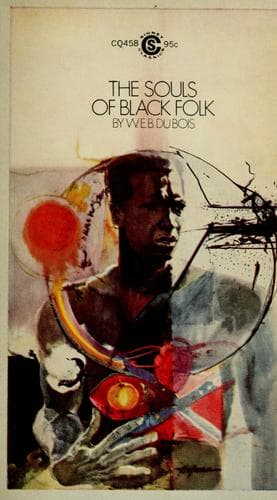
The Souls of Black FolkDu Bois, W. E. B. (William Edward Burghardt)
History
The Souls of Black Folk
Du Bois, W. E. B. (William Edward Burghardt)
African Americans
Thus he grew in body and soul, and with him his clothes seemed to grow
and arrange themselves; coat sleeves got longer, cuffs appeared, and
collars got less soiled. Now and then his boots shone, and a new
dignity crept into his walk. And we who saw daily a new thoughtfulness
growing in his eyes began to expect something of this plodding boy.
Thus he passed out of the preparatory school into college, and we who
watched him felt four more years of change, which almost transformed
the tall, grave man who bowed to us commencement morning. He had left
his queer thought-world and come back to a world of motion and of men.
He looked now for the first time sharply about him, and wondered he had
seen so little before. He grew slowly to feel almost for the first time
the Veil that lay between him and the white world; he first noticed now
the oppression that had not seemed oppression before, differences that
erstwhile seemed natural, restraints and slights that in his boyhood
days had gone unnoticed or been greeted with a laugh. He felt angry now
when men did not call him “Mister,” he clenched his hands at the “Jim
Crow” cars, and chafed at the color-line that hemmed in him and his. A
tinge of sarcasm crept into his speech, and a vague bitterness into his
life; and he sat long hours wondering and planning a way around these
crooked things. Daily he found himself shrinking from the choked and
narrow life of his native town. And yet he always planned to go back to
Altamaha,—always planned to work there. Still, more and more as the day
approached he hesitated with a nameless dread; and even the day after
graduation he seized with eagerness the offer of the Dean to send him
North with the quartette during the summer vacation, to sing for the
Institute. A breath of air before the plunge, he said to himself in
half apology.
It was a bright September afternoon, and the streets of New York were
brilliant with moving men. They reminded John of the sea, as he sat in
the square and watched them, so changelessly changing, so bright and
dark, so grave and gay. He scanned their rich and faultless clothes,
the way they carried their hands, the shape of their hats; he peered
into the hurrying carriages. Then, leaning back with a sigh, he said,
“This is the World.” The notion suddenly seized him to see where the
world was going; since many of the richer and brighter seemed hurrying
all one way. So when a tall, light-haired young man and a little
talkative lady came by, he rose half hesitatingly and followed them. Up
the street they went, past stores and gay shops, across a broad square,
until with a hundred others they entered the high portal of a great
building.
Public-domain text, read in full here on John Shaqi.
Reviews
Reviews
No reviews yet
Be the first to share your thoughts on this work.
Elsewhere in the archive
Join the Discussion
Join the discussion
Sign in to leave a comment or review.
Sign InorCreate an account