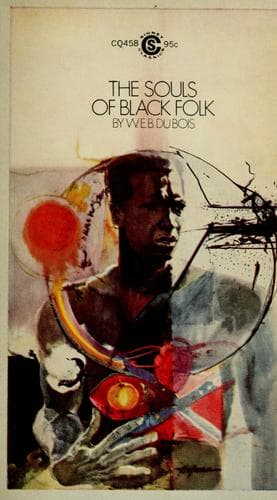
The Souls of Black FolkDu Bois, W. E. B. (William Edward Burghardt)
History
The Souls of Black Folk
Du Bois, W. E. B. (William Edward Burghardt)
African Americans
He was pushed toward the ticket-office with the others, and felt in his
pocket for the new five-dollar bill he had hoarded. There seemed really
no time for hesitation, so he drew it bravely out, passed it to the
busy clerk, and received simply a ticket but no change. When at last he
realized that he had paid five dollars to enter he knew not what, he
stood stockstill amazed. “Be careful,” said a low voice behind him;
“you must not lynch the colored gentleman simply because he’s in your
way,” and a girl looked up roguishly into the eyes of her fair-haired
escort. A shade of annoyance passed over the escort’s face. “You _will_
not understand us at the South,” he said half impatiently, as if
continuing an argument. “With all your professions, one never sees in
the North so cordial and intimate relations between white and black as
are everyday occurrences with us. Why, I remember my closest playfellow
in boyhood was a little Negro named after me, and surely no
two,—_well_!” The man stopped short and flushed to the roots of his
hair, for there directly beside his reserved orchestra chairs sat the
Negro he had stumbled over in the hallway. He hesitated and grew pale
with anger, called the usher and gave him his card, with a few
peremptory words, and slowly sat down. The lady deftly changed the
subject.
All this John did not see, for he sat in a half-daze minding the scene
about him; the delicate beauty of the hall, the faint perfume, the
moving myriad of men, the rich clothing and low hum of talking seemed
all a part of a world so different from his, so strangely more
beautiful than anything he had known, that he sat in dreamland, and
started when, after a hush, rose high and clear the music of
Lohengrin’s swan. The infinite beauty of the wail lingered and swept
through every muscle of his frame, and put it all a-tune. He closed his
eyes and grasped the elbows of the chair, touching unwittingly the
lady’s arm. And the lady drew away. A deep longing swelled in all his
heart to rise with that clear music out of the dirt and dust of that
low life that held him prisoned and befouled. If he could only live up
in the free air where birds sang and setting suns had no touch of
blood! Who had called him to be the slave and butt of all? And if he
had called, what right had he to call when a world like this lay open
before men?
Public-domain text, read in full here on John Shaqi.
Reviews
Reviews
No reviews yet
Be the first to share your thoughts on this work.
Elsewhere in the archive
Join the Discussion
Join the discussion
Sign in to leave a comment or review.
Sign InorCreate an account