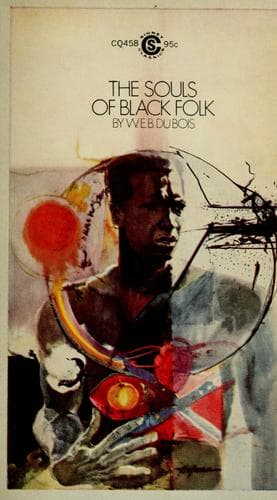
The Souls of Black FolkDu Bois, W. E. B. (William Edward Burghardt)
History
The Souls of Black Folk
Du Bois, W. E. B. (William Edward Burghardt)
African Americans
There was once a blacksmith’s son born at Cadiz, New York, who in the
changes of time taught school in Ohio and helped defend Cincinnati from
Kirby Smith. Then he fought at Chancellorsville and Gettysburg and
finally served in the Freedmen’s Bureau at Nashville. Here he formed a
Sunday-school class of black children in 1866, and sang with them and
taught them to sing. And then they taught him to sing, and when once
the glory of the Jubilee songs passed into the soul of George L. White,
he knew his life-work was to let those Negroes sing to the world as
they had sung to him. So in 1871 the pilgrimage of the Fisk Jubilee
Singers began. North to Cincinnati they rode,—four half-clothed black
boys and five girl-women,—led by a man with a cause and a purpose. They
stopped at Wilberforce, the oldest of Negro schools, where a black
bishop blessed them. Then they went, fighting cold and starvation, shut
out of hotels, and cheerfully sneered at, ever northward; and ever the
magic of their song kept thrilling hearts, until a burst of applause in
the Congregational Council at Oberlin revealed them to the world. They
came to New York and Henry Ward Beecher dared to welcome them, even
though the metropolitan dailies sneered at his “Nigger Minstrels.” So
their songs conquered till they sang across the land and across the
sea, before Queen and Kaiser, in Scotland and Ireland, Holland and
Switzerland. Seven years they sang, and brought back a hundred and
fifty thousand dollars to found Fisk University.
Since their day they have been imitated—sometimes well, by the singers
of Hampton and Atlanta, sometimes ill, by straggling quartettes.
Caricature has sought again to spoil the quaint beauty of the music,
and has filled the air with many debased melodies which vulgar ears
scarce know from the real. But the true Negro folk-song still lives in
the hearts of those who have heard them truly sung and in the hearts of
the Negro people.
What are these songs, and what do they mean? I know little of music and
can say nothing in technical phrase, but I know something of men, and
knowing them, I know that these songs are the articulate message of the
slave to the world. They tell us in these eager days that life was
joyous to the black slave, careless and happy. I can easily believe
this of some, of many. But not all the past South, though it rose from
the dead, can gainsay the heart-touching witness of these songs. They
are the music of an unhappy people, of the children of disappointment;
they tell of death and suffering and unvoiced longing toward a truer
world, of misty wanderings and hidden ways.
Public-domain text, read in full here on John Shaqi.
Reviews
Reviews
No reviews yet
Be the first to share your thoughts on this work.
Elsewhere in the archive
Join the Discussion
Join the discussion
Sign in to leave a comment or review.
Sign InorCreate an account