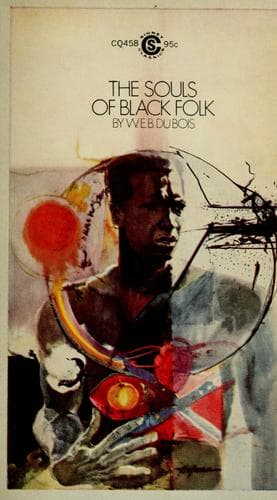
The Souls of Black FolkDu Bois, W. E. B. (William Edward Burghardt)
History
The Souls of Black Folk
Du Bois, W. E. B. (William Edward Burghardt)
African Americans
There are many others of the Negro folk-songs as striking and
characteristic as these, as, for instance, the three strains in the
third, eighth, and ninth chapters; and others I am sure could easily
make a selection on more scientific principles. There are, too, songs
that seem to be a step removed from the more primitive types: there is
the maze-like medley, “Bright sparkles,” one phrase of which heads “The
Black Belt”; the Easter carol, “Dust, dust and ashes”; the dirge, “My
mother’s took her flight and gone home”; and that burst of melody
hovering over “The Passing of the First-Born”—“I hope my mother will be
there in that beautiful world on high.”
These represent a third step in the development of the slave song, of
which “You may bury me in the East” is the first, and songs like “March
on” (chapter six) and “Steal away” are the second. The first is African
music, the second Afro-American, while the third is a blending of Negro
music with the music heard in the foster land. The result is still
distinctively Negro and the method of blending original, but the
elements are both Negro and Caucasian. One might go further and find a
fourth step in this development, where the songs of white America have
been distinctively influenced by the slave songs or have incorporated
whole phrases of Negro melody, as “Swanee River” and “Old Black Joe.”
Side by side, too, with the growth has gone the debasements and
imitations—the Negro “minstrel” songs, many of the “gospel” hymns, and
some of the contemporary “coon” songs,—a mass of music in which the
novice may easily lose himself and never find the real Negro melodies.
In these songs, I have said, the slave spoke to the world. Such a
message is naturally veiled and half articulate. Words and music have
lost each other and new and cant phrases of a dimly understood theology
have displaced the older sentiment. Once in a while we catch a strange
word of an unknown tongue, as the “Mighty Myo,” which figures as a
river of death; more often slight words or mere doggerel are joined to
music of singular sweetness. Purely secular songs are few in number,
partly because many of them were turned into hymns by a change of
words, partly because the frolics were seldom heard by the stranger,
and the music less often caught. Of nearly all the songs, however, the
music is distinctly sorrowful. The ten master songs I have mentioned
tell in word and music of trouble and exile, of strife and hiding; they
grope toward some unseen power and sigh for rest in the End.
Public-domain text, read in full here on John Shaqi.
Reviews
Reviews
No reviews yet
Be the first to share your thoughts on this work.
Elsewhere in the archive
Join the Discussion
Join the discussion
Sign in to leave a comment or review.
Sign InorCreate an account