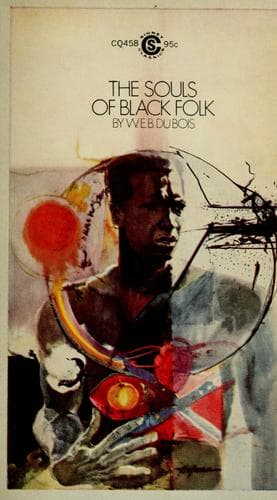
The Souls of Black FolkDu Bois, W. E. B. (William Edward Burghardt)
History
The Souls of Black Folk
Du Bois, W. E. B. (William Edward Burghardt)
African Americans
The words that are left to us are not without interest, and, cleared of
evident dross, they conceal much of real poetry and meaning beneath
conventional theology and unmeaning rhapsody. Like all primitive folk,
the slave stood near to Nature’s heart. Life was a “rough and rolling
sea” like the brown Atlantic of the Sea Islands; the “Wilderness” was
the home of God, and the “lonesome valley” led to the way of life.
“Winter’ll soon be over,” was the picture of life and death to a
tropical imagination. The sudden wild thunderstorms of the South awed
and impressed the Negroes,—at times the rumbling seemed to them
“mournful,” at times imperious:
“My Lord calls me,
He calls me by the thunder,
The trumpet sounds it in my soul.”
The monotonous toil and exposure is painted in many words. One sees the
ploughmen in the hot, moist furrow, singing:
“Dere’s no rain to wet you,
Dere’s no sun to burn you,
Oh, push along, believer,
I want to go home.”
The bowed and bent old man cries, with thrice-repeated wail:
“O Lord, keep me from sinking down,”
and he rebukes the devil of doubt who can whisper:
“Jesus is dead and God’s gone away.”
Yet the soul-hunger is there, the restlessness of the savage, the wail
of the wanderer, and the plaint is put in one little phrase:
[Illustration]
Over the inner thoughts of the slaves and their relations one with
another the shadow of fear ever hung, so that we get but glimpses here
and there, and also with them, eloquent omissions and silences. Mother
and child are sung, but seldom father; fugitive and weary wanderer call
for pity and affection, but there is little of wooing and wedding; the
rocks and the mountains are well known, but home is unknown. Strange
blending of love and helplessness sings through the refrain:
“Yonder’s my ole mudder,
Been waggin’ at de hill so long;
’Bout time she cross over,
Git home bime-by.”
Elsewhere comes the cry of the “motherless” and the “Farewell,
farewell, my only child.”
Love-songs are scarce and fall into two categories—the frivolous and
light, and the sad. Of deep successful love there is ominous silence,
and in one of the oldest of these songs there is a depth of history and
meaning:
[Illustration]
A black woman said of the song, “It can’t be sung without a full heart
and a troubled sperrit.” The same voice sings here that sings in the
German folk-song:
“Jetz Geh i’ an’s brunele, trink’ aber net.”
Of death the Negro showed little fear, but talked of it familiarly and
even fondly as simply a crossing of the waters, perhaps—who knows?—back
to his ancient forests again. Later days transfigured his fatalism, and
amid the dust and dirt the toiler sang:
“Dust, dust and ashes, fly over my grave,
But the Lord shall bear my spirit home.”
Public-domain text, read in full here on John Shaqi.
Reviews
Reviews
No reviews yet
Be the first to share your thoughts on this work.
Elsewhere in the archive
Join the Discussion
Join the discussion
Sign in to leave a comment or review.
Sign InorCreate an account