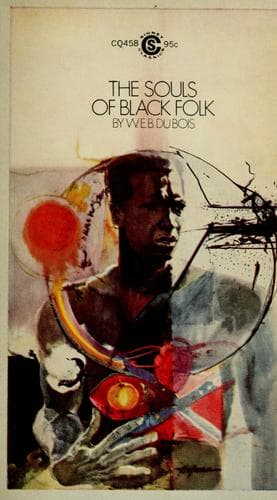
The Souls of Black FolkDu Bois, W. E. B. (William Edward Burghardt)
History
The Souls of Black Folk
Du Bois, W. E. B. (William Edward Burghardt)
African Americans
The things evidently borrowed from the surrounding world undergo
characteristic change when they enter the mouth of the slave.
Especially is this true of Bible phrases. “Weep, O captive daughter of
Zion,” is quaintly turned into “Zion, weep-a-low,” and the wheels of
Ezekiel are turned every way in the mystic dreaming of the slave, till
he says:
“There’s a little wheel a-turnin’ in-a-my heart.”
As in olden time, the words of these hymns were improvised by some
leading minstrel of the religious band. The circumstances of the
gathering, however, the rhythm of the songs, and the limitations of
allowable thought, confined the poetry for the most part to single or
double lines, and they seldom were expanded to quatrains or longer
tales, although there are some few examples of sustained efforts,
chiefly paraphrases of the Bible. Three short series of verses have
always attracted me,—the one that heads this chapter, of one line of
which Thomas Wentworth Higginson has fittingly said, “Never, it seems
to me, since man first lived and suffered was his infinite longing for
peace uttered more plaintively.” The second and third are descriptions
of the Last Judgment,—the one a late improvisation, with some traces of
outside influence:
“Oh, the stars in the elements are falling,
And the moon drips away into blood,
And the ransomed of the Lord are returning unto God,
Blessed be the name of the Lord.”
And the other earlier and homelier picture from the low coast lands:
“Michael, haul the boat ashore,
Then you’ll hear the horn they blow,
Then you’ll hear the trumpet sound,
Trumpet sound the world around,
Trumpet sound for rich and poor,
Trumpet sound the Jubilee,
Trumpet sound for you and me.”
Through all the sorrow of the Sorrow Songs there breathes a hope—a
faith in the ultimate justice of things. The minor cadences of despair
change often to triumph and calm confidence. Sometimes it is faith in
life, sometimes a faith in death, sometimes assurance of boundless
justice in some fair world beyond. But whichever it is, the meaning is
always clear: that sometime, somewhere, men will judge men by their
souls and not by their skins. Is such a hope justified? Do the Sorrow
Songs sing true?
Public-domain text, read in full here on John Shaqi.
Reviews
Reviews
No reviews yet
Be the first to share your thoughts on this work.
Elsewhere in the archive
Join the Discussion
Join the discussion
Sign in to leave a comment or review.
Sign InorCreate an account