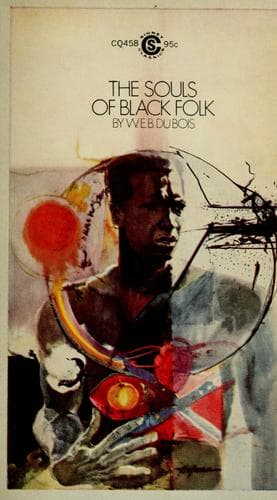
The Souls of Black FolkDu Bois, W. E. B. (William Edward Burghardt)
History
The Souls of Black Folk
Du Bois, W. E. B. (William Edward Burghardt)
African Americans
This group of men honor Mr. Washington for his attitude of conciliation
toward the white South; they accept the “Atlanta Compromise” in its
broadest interpretation; they recognize, with him, many signs of
promise, many men of high purpose and fair judgment, in this section;
they know that no easy task has been laid upon a region already
tottering under heavy burdens. But, nevertheless, they insist that the
way to truth and right lies in straightforward honesty, not in
indiscriminate flattery; in praising those of the South who do well and
criticising uncompromisingly those who do ill; in taking advantage of
the opportunities at hand and urging their fellows to do the same, but
at the same time in remembering that only a firm adherence to their
higher ideals and aspirations will ever keep those ideals within the
realm of possibility. They do not expect that the free right to vote,
to enjoy civic rights, and to be educated, will come in a moment; they
do not expect to see the bias and prejudices of years disappear at the
blast of a trumpet; but they are absolutely certain that the way for a
people to gain their reasonable rights is not by voluntarily throwing
them away and insisting that they do not want them; that the way for a
people to gain respect is not by continually belittling and ridiculing
themselves; that, on the contrary, Negroes must insist continually, in
season and out of season, that voting is necessary to modern manhood,
that color discrimination is barbarism, and that black boys need
education as well as white boys.
In failing thus to state plainly and unequivocally the legitimate
demands of their people, even at the cost of opposing an honored
leader, the thinking classes of American Negroes would shirk a heavy
responsibility,—a responsibility to themselves, a responsibility to the
struggling masses, a responsibility to the darker races of men whose
future depends so largely on this American experiment, but especially a
responsibility to this nation,—this common Fatherland. It is wrong to
encourage a man or a people in evil-doing; it is wrong to aid and abet
a national crime simply because it is unpopular not to do so. The
growing spirit of kindliness and reconciliation between the North and
South after the frightful difference of a generation ago ought to be a
source of deep congratulation to all, and especially to those whose
mistreatment caused the war; but if that reconciliation is to be marked
by the industrial slavery and civic death of those same black men, with
permanent legislation into a position of inferiority, then those black
men, if they are really men, are called upon by every consideration of
patriotism and loyalty to oppose such a course by all civilized
methods, even though such opposition involves disagreement with Mr.
Booker T. Washington. We have no right to sit silently by while the
inevitable seeds are sown for a harvest of disaster to our children,
black and white.
Public-domain text, read in full here on John Shaqi.
Reviews
Reviews
No reviews yet
Be the first to share your thoughts on this work.
Join the Discussion
Join the discussion
Sign in to leave a comment or review.
Sign InorCreate an account