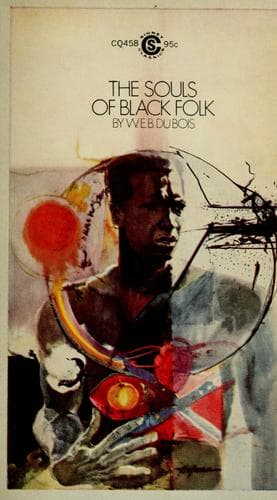
The Souls of Black FolkDu Bois, W. E. B. (William Edward Burghardt)
History
The Souls of Black Folk
Du Bois, W. E. B. (William Edward Burghardt)
African Americans
It would be unjust to Mr. Washington not to acknowledge that in several
instances he has opposed movements in the South which were unjust to
the Negro; he sent memorials to the Louisiana and Alabama
constitutional conventions, he has spoken against lynching, and in
other ways has openly or silently set his influence against sinister
schemes and unfortunate happenings. Notwithstanding this, it is equally
true to assert that on the whole the distinct impression left by Mr.
Washington’s propaganda is, first, that the South is justified in its
present attitude toward the Negro because of the Negro’s degradation;
secondly, that the prime cause of the Negro’s failure to rise more
quickly is his wrong education in the past; and, thirdly, that his
future rise depends primarily on his own efforts. Each of these
propositions is a dangerous half-truth. The supplementary truths must
never be lost sight of: first, slavery and race-prejudice are potent if
not sufficient causes of the Negro’s position; second, industrial and
common-school training were necessarily slow in planting because they
had to await the black teachers trained by higher institutions,—it
being extremely doubtful if any essentially different development was
possible, and certainly a Tuskegee was unthinkable before 1880; and,
third, while it is a great truth to say that the Negro must strive and
strive mightily to help himself, it is equally true that unless his
striving be not simply seconded, but rather aroused and encouraged, by
the initiative of the richer and wiser environing group, he cannot hope
for great success.
In his failure to realize and impress this last point, Mr. Washington
is especially to be criticised. His doctrine has tended to make the
whites, North and South, shift the burden of the Negro problem to the
Negro’s shoulders and stand aside as critical and rather pessimistic
spectators; when in fact the burden belongs to the nation, and the
hands of none of us are clean if we bend not our energies to righting
these great wrongs.
The South ought to be led, by candid and honest criticism, to assert
her better self and do her full duty to the race she has cruelly
wronged and is still wronging. The North—her co-partner in guilt—cannot
salve her conscience by plastering it with gold. We cannot settle this
problem by diplomacy and suaveness, by “policy” alone. If worse come to
worst, can the moral fibre of this country survive the slow throttling
and murder of nine millions of men?
Public-domain text, read in full here on John Shaqi.
Reviews
Reviews
No reviews yet
Be the first to share your thoughts on this work.
Join the Discussion
Join the discussion
Sign in to leave a comment or review.
Sign InorCreate an account