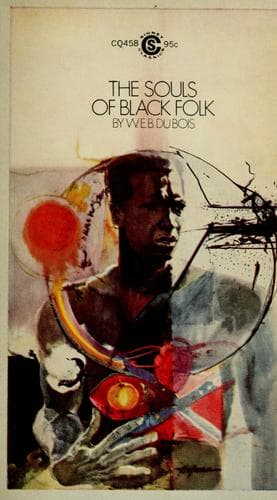
The Souls of Black FolkDu Bois, W. E. B. (William Edward Burghardt)
History
The Souls of Black Folk
Du Bois, W. E. B. (William Edward Burghardt)
African Americans
For two summers I lived in this little world; it was dull and humdrum.
The girls looked at the hill in wistful longing, and the boys fretted
and haunted Alexandria. Alexandria was “town,”—a straggling, lazy
village of houses, churches, and shops, and an aristocracy of Toms,
Dicks, and Captains. Cuddled on the hill to the north was the village
of the colored folks, who lived in three- or four-room unpainted
cottages, some neat and homelike, and some dirty. The dwellings were
scattered rather aimlessly, but they centred about the twin temples of
the hamlet, the Methodist, and the Hard-Shell Baptist churches. These,
in turn, leaned gingerly on a sad-colored schoolhouse. Hither my little
world wended its crooked way on Sunday to meet other worlds, and
gossip, and wonder, and make the weekly sacrifice with frenzied priest
at the altar of the “old-time religion.” Then the soft melody and
mighty cadences of Negro song fluttered and thundered.
I have called my tiny community a world, and so its isolation made it;
and yet there was among us but a half-awakened common consciousness,
sprung from common joy and grief, at burial, birth, or wedding; from a
common hardship in poverty, poor land, and low wages; and, above all,
from the sight of the Veil that hung between us and Opportunity. All
this caused us to think some thoughts together; but these, when ripe
for speech, were spoken in various languages. Those whose eyes
twenty-five and more years before had seen “the glory of the coming of
the Lord,” saw in every present hindrance or help a dark fatalism bound
to bring all things right in His own good time. The mass of those to
whom slavery was a dim recollection of childhood found the world a
puzzling thing: it asked little of them, and they answered with little,
and yet it ridiculed their offering. Such a paradox they could not
understand, and therefore sank into listless indifference, or
shiftlessness, or reckless bravado. There were, however, some—such as
Josie, Jim, and Ben—to whom War, Hell, and Slavery were but childhood
tales, whose young appetites had been whetted to an edge by school and
story and half-awakened thought. Ill could they be content, born
without and beyond the World. And their weak wings beat against their
barriers,—barriers of caste, of youth, of life; at last, in dangerous
moments, against everything that opposed even a whim.
The ten years that follow youth, the years when first the realization
comes that life is leading somewhere,—these were the years that passed
after I left my little school. When they were past, I came by chance
once more to the walls of Fisk University, to the halls of the chapel
of melody. As I lingered there in the joy and pain of meeting old
school-friends, there swept over me a sudden longing to pass again
beyond the blue hill, and to see the homes and the school of other
days, and to learn how life had gone with my school-children; and I
went.
Public-domain text, read in full here on John Shaqi.
Reviews
Reviews
No reviews yet
Be the first to share your thoughts on this work.
Join the Discussion
Join the discussion
Sign in to leave a comment or review.
Sign InorCreate an account