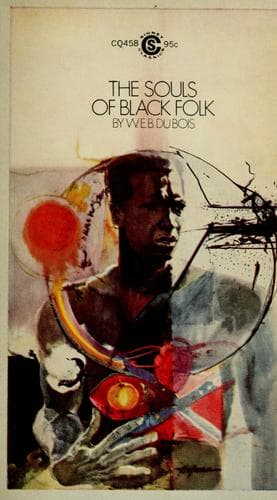
The Souls of Black FolkDu Bois, W. E. B. (William Edward Burghardt)
History
The Souls of Black Folk
Du Bois, W. E. B. (William Edward Burghardt)
African Americans
My log schoolhouse was gone. In its place stood Progress; and Progress,
I understand, is necessarily ugly. The crazy foundation stones still
marked the former site of my poor little cabin, and not far away, on
six weary boulders, perched a jaunty board house, perhaps twenty by
thirty feet, with three windows and a door that locked. Some of the
window-glass was broken, and part of an old iron stove lay mournfully
under the house. I peeped through the window half reverently, and found
things that were more familiar. The blackboard had grown by about two
feet, and the seats were still without backs. The county owns the lot
now, I hear, and every year there is a session of school. As I sat by
the spring and looked on the Old and the New I felt glad, very glad,
and yet—
After two long drinks I started on. There was the great double
log-house on the corner. I remembered the broken, blighted family that
used to live there. The strong, hard face of the mother, with its
wilderness of hair, rose before me. She had driven her husband away,
and while I taught school a strange man lived there, big and jovial,
and people talked. I felt sure that Ben and ’Tildy would come to naught
from such a home. But this is an odd world; for Ben is a busy farmer in
Smith County, “doing well, too,” they say, and he had cared for little
’Tildy until last spring, when a lover married her. A hard life the lad
had led, toiling for meat, and laughed at because he was homely and
crooked. There was Sam Carlon, an impudent old skinflint, who had
definite notions about “niggers,” and hired Ben a summer and would not
pay him. Then the hungry boy gathered his sacks together, and in broad
daylight went into Carlon’s corn; and when the hard-fisted farmer set
upon him, the angry boy flew at him like a beast. Doc Burke saved a
murder and a lynching that day.
The story reminded me again of the Burkes, and an impatience seized me
to know who won in the battle, Doc or the seventy-five acres. For it is
a hard thing to make a farm out of nothing, even in fifteen years. So I
hurried on, thinking of the Burkes. They used to have a certain
magnificent barbarism about them that I liked. They were never vulgar,
never immoral, but rather rough and primitive, with an
unconventionality that spent itself in loud guffaws, slaps on the back,
and naps in the corner. I hurried by the cottage of the misborn Neill
boys. It was empty, and they were grown into fat, lazy farm-hands. I
saw the home of the Hickmans, but Albert, with his stooping shoulders,
had passed from the world. Then I came to the Burkes’ gate and peered
through; the enclosure looked rough and untrimmed, and yet there were
the same fences around the old farm save to the left, where lay
twenty-five other acres. And lo! the cabin in the hollow had climbed
the hill and swollen to a half-finished six-room cottage.
Public-domain text, read in full here on John Shaqi.
Reviews
Reviews
No reviews yet
Be the first to share your thoughts on this work.
Join the Discussion
Join the discussion
Sign in to leave a comment or review.
Sign InorCreate an account